How to Increase Student Energy Level in Shakespeare Performances

Hesitant, inexperienced, and nervous student actors often rehearse and perform with all the urgency of a snail creeping unwillingly to school. They find it difficult to understand the importance of energy without concrete instruction. Thus, giving them an anchor of various energy levels often help elucidate the subject for them.

Here is the script I use for this activity. I model each level by doing the activity with the students.

Okay, this activity is called the Seven Levels of Energy.
No Energy!

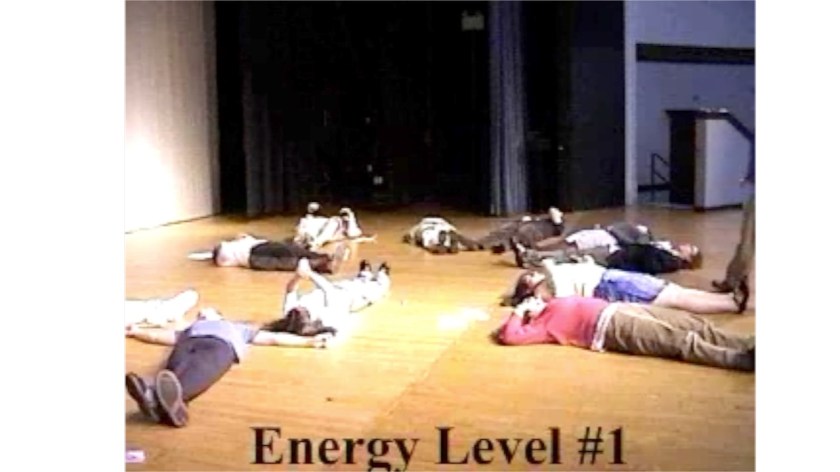
Energy Level #1

So, everyone lie down on the floor. Yes…on the floor. On your backs. Eyes closed. This is energy level number one. Imagine that gravity, an overwhelming force, pushes you into the floor. You are like a pool of liquid. You are so tired that you can barely lift your fingers. Go ahead, struggle to lift a finger. It’s Monday morning and you struggle to get out of bed at energy level number one.

Energy Level #2

Fortunately, or unfortunately, depending on how you look at it, we can’t stay at energy level number one. We have things to do. So, at energy level number two, which takes all of your effort and concentration, struggle to your feet. That’s right, do that now…struggle to your feet where you can barely stand because it feels like you have a thousand pounds on your back. You even stagger a bit trying to maintain your balance. Nope, you can’t talk at energy level number two, you can barely stand. Feel that weight on your back. Okay, good.

Energy Level #3

Well, we can’t stay at energy level number two, either, so let’s go find the coffee machine. At energy level number three, if we concentrate really hard, we can move from point A to point B. We may sway a bit, side to side because we’ve still got that heavy weight on our back. Nope, still can’t talk at energy level number 3, it takes all our concentration to get to one spot. Then we have to pause, rest then get to the next spot.

Energy Level #4

Now that we’ve had our coffee, we can move onto energy level number four. This is normal everyday walking around with no particular purpose. Oh, there’s people in this world. Yes, now we can talk to them. “Hey, how’s it going? Good. You?” Yup, just walking around with no particular purpose, no urgency. Not like you guys, of course, but perhaps some of my less motivated students…. Just walking around normally. Ho-hum. The thing is, with energy level number four, nothing gets done. There are no stakes, nothing matter, no one cares. Until we get to energy level number five.

Energy Level #5

Okay, now we’ve got purpose! We have goals to accomplish! I need to move this chair over here. I need to carry this backpack over there. Very Important! This needs to be done and done correctly or there will be consequences…significant consequences. I need to come over here and tell Jack that our performance today is essential to our success! Very important! Move with purpose. Move with urgency. Pick up the pace. I have clear objectives, clear goals. I’m motivated.

Energy Level #6

When we get to energy level six, we’re late! We’ve got to run! It’s critical! Lives are at stake! Our future! Run, run, run! This has to be done NOW!! The essay is due in 15 minutes! I need to score the winning touchdown! Go, go, go! Something really bad is going to happen if we don’t get this done! High stakes! We must not fail!
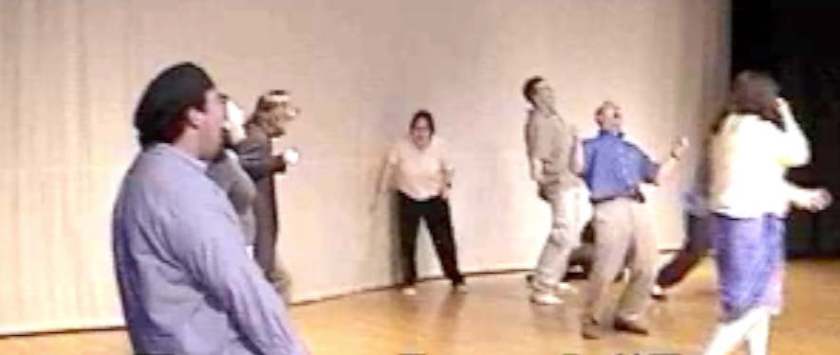
Energy!!!

Energy Level #7

When we get all worked up, we sometimes move to energy level number seven where all we can do is scream: “AHHHHHHHHRGGGGHHHHHH!” and collapse to the floor. Back to energy level number one. We’re exhausted again and feel heavy. Kind of feels like most days of my life…

Debriefing

After completing the activity, I gather students in a circle to talk about it. I always ask, in theater, which energy level should we avoid like the plague? Inevitably they say, “Number one!” to which I reply, “My friend, Mark, once played Julius Ceasar. After they stabbed him he had to lie on stage for 15 minutes of Mark Antony’s speech. He was in three shows and was tired. I often had to kick him so he would stop snoring. That’s pretty much energy level number one”

“Okay, energy level number two.”

“Imagine you are wounded, or really old. I’ll bet you would walk like that…hunched over, feeling like you had a heavy weight on your back.”

“Okay, four! Yeah, energy level number four, avoid that.”

Exactly. Energy level number four doesn’t “read.” It communicates nothing. It’s emotionless. One, two and three can show several different emotional states. Six and seven, definitely. But four? Boring. Uninvolved. Purposeless.

I suggest focusing on energy level number five. Make sure your character work to accomplish something. Know what they want and that getting it is important to them. If your characters don’t care, the audience won’t care and they’ll be bored with your scene.

Think of theater like the Arnold Schwarzenegger movie Kindergarten Cop. Has anyone seen it? No? I know, I’m getting too old. Anyway, in this movie, Arnold plays a police officer. He’s used to getting what he wants, justice, by beating up bad guys. However, when he takes an undercover job as a kindergarten teacher, he can’t beat up little kids, so has to learn to use LANGUAGE to achieve his goals. That’s what theater is all about. Think about how your character uses words to accomplish goals.

Bonus Strategies

Although the Seven Levels of Energy activity works well to communicate the theory, sometimes students need some additional practice to put the concept into practice. If I see a group hovering around energy level number four, I usually give them two additional challenges.

Four Corners

I place each of the scene members in the four corners of the performing space…the farther apart, the better. If we rehearse in the auditorium, I tell them to stand way out in the corners of the seats. “Okay,” I say. “Stay in character and project your lines across the space to your scene partners.” While this challenge works well for “soft talkers” as well, it helps to increase the energy with which they speak.

Speed-through

Another strategy I use to increase energy levels is the speed-through. I tell students to literally RUN through the scene, speaking as quickly as possible without losing any of the sounds of their words. Imagine that you are racing another group performing the same scene. If you drop any words, you’d have to restart, so maintain line integrity, but GO FAST! This often creates the urgency necessary to transform a lackluster energy level to a more dynamic one.

Fun Fact

I was presenting this activity at a conference in Denver one year and during energy level number six someone moved my presentation notes. I never found them. Luckily I had my presentation pretty well anchored in my head so we were able to press on without any problems. It was a fun group and well worth losing notes!

Acting Shakespeare can understandably intimidate students and inexperienced actors. This reluctance often translates into dull scenes that do little to combat the notion that Shakespeare plays are lively and dynamic. However, these teaching strategies will help reticent students understand the appropriate energy level necessary for entertaining scenes!
Teaching Shakespeare’s Wordplay in Romeo and Juliet

You have reviewed puns, shown examples, and discussed why they’re funny.  Activate Prior Knowledge? Check! You begin the opening scene to Romeo and Juliet and model raucous laughter at the appropriate (and inappropriate) parts.  And yet the students still look at you like you’ve sniffed too much glue. Then you realize…they’re right.  These old references just aren’t that funny to modern audiences. Throw a couple of pool noodles into the mix, however,  and you can transform archaic language into uproarious comedy.

More Matter, Less Art…

After you’ve done your due diligence by explaining puns, hand out a copy of the Sampson and Gregory in Act 1 Scene 1. (You can download a blank copy here, and a completed one here.)  Tell students to look for similar-looking words that could indicate a pun. They should then circle the punning word and draw an arrow back to the word it puns against.  For example:

I model the first three lines with class; then students work through the rest of the passage with a partner.  After they have identified the puns, we complete a little formative assessment and review their choices. “Back in the day,” as my students love to say, I used this almost-as-archaic-as-the-puns-themselves device known as an overhead projector.  Using a dry erase marker to draw circles and arrows (“And a paragraph on the back explaining what each one was to be used as evidence against us!” Sorry…couldn’t resist.) I explained each line. These days, I usually project my screen and simply highlight the puns as students follow along and make adjustments as necessary.  With a tablet, I’m sure you could upload the text and then use a drawing app as a visual reference for students.

Before getting too deep into this activity, I also consider my audience.  The puns at line 20 become sexual as Sampson and Gregory take bawdy stabs at each other.  Gregory, with stereotypical male swagger, claims that he will “cut off the heads of the maids…Take it in what sense thou wilt.”  Sampson, belittling Gregory’s male equipage, responds, “They must take it in sense that feel it.” Not to be put down, Sampson maintains that  “me they shall feel when I am able to stand.”

It is up to the teacher’s style, community attitude, and student maturity how, or if to deal with this subject matter.  When I workshop this scene with middle schoolers, I cut this part out. Most of my high school students get the jokes themselves when I simply explain that these jokes refer to virginity and “the apparent state and size of a part of male anatomy.”  Attention is usually rapt at this point.

Suit the Action to the Word

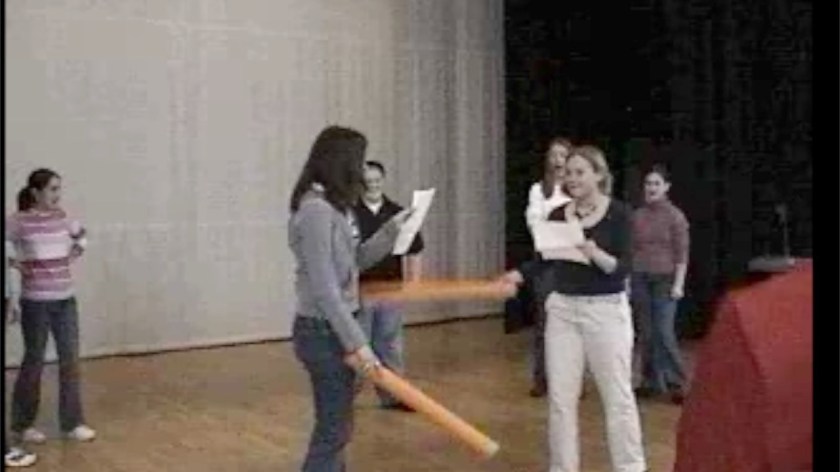
Then I pull out the nerf noodles.  Waving them around usually ensures a rapid and enthusiastic mustering of willing participants.  I choose two students to read and tell the rest of the class that they must help act it out. I give the readers the noodles and tell them that whenever they come to a circled word that has an arrow pointed back to the other character’s word, they get to whack them with the noodle  The only two places they can hit them, though, are the shoulder and the hip. (With some high school boys, especially, we’d have to begin concussion protocol if they were allowed to hit each other in the head!) Also, I remind them that they are friends and not enemies. This is a verbal joust for fun, not mortal combat.  (That comes later!)

In order to emphasize the playfulness of the text, I set the scene.  I tell students to imagine that they have just finished lunch and are hanging around waiting until it’s time to go back to class or work.  Sampson and Gregory have started talking and making jokes at each other. At each palpable hit, the audience students must laugh uproariously, even if it isn’t overly funny.  This helps set up not only the mood of the scene but also provides something for Sampson and Gregory to play off. Furthermore, their participation invites engagement from everyone and not just the readers.

Then off we go!  Sometimes I have to encourage more reticent students to increase the enthusiasm of their laughing, but suddenly, dull, boring and archaic language becomes engaging.  Many times, too, Sampson and Gregory start playing to the audience, pausing for dramatic effect, and taking bows. The energy from the audience pushes them to a point where they can simply react as opposed to worry about how to act.

Then we get to the brawl, but that’s a subject for another post….

Our Revels Are Now Ended

After completing the scene I like to discuss its impact.  How did students like the activity? What mood did the scene generate?  Why does Shakespeare open the play like this? Students often present insightful ideas here and debriefing the experience often solidifies the idea that “Hey, this Shakespeare unit might be fun after all!”

Although I love opening Romeo and Juliet with this activity, it can be effective for other Shakespearean word-play situations as well. For example, I often use it for Beatrice and Benedick, in Much Ado, Falstaff in and Hal in Henry IV Part 1, Lorenzo and Lancelot Gobbo in Merchant of Venice or Feste in Twelfth Night.  I love it because of its balance.  The close textual reading requires students to really grapple with sophisticated language, however, they discover the rewards in a fun, engaging, visceral and visual experience to truly solidify their learning.


So break out those pool noodles!  By beginning the Romeo and Juliet unit with a “15 Minute” play activity, then further engage them with the wordplay of this scene, your students will come to class the next day and excitedly ask, “Are we doing Shakespeare today?”

How I Evolved to Teaching Shakespeare through Performance

-Ted Tibbetts

We spend way too much time unpacking the language of rubrics.  And, yes, I know, we want to make learning objectives clear for our students.  And, yes, we want instruction, in some degree, to be data-driven. But when I think of the amount to time we spend sitting around in meetings trying to cram content into a digital receptacle and trying to pinpoint what we really mean by “sophisticated topic development,”  I feel like a fly to the wanton gods. The most important learning can’t be measured in rubrics.

I was never an actor.  In high school musicals, I played trombone in the pit band.  In college, I played guitar and sang the songs with a lot of lyrics.  (I was the only one who could remember all the words.) Throughout that time, however, I became more and more interested in Shakespeare.  In graduate school, I TA’d for a Shakespeare class. Then I saw audition signs for Much Ado About Nothing.  I figured if I truly was going to do this “Shakespeare Thing,” (whatever that was) I should experience it from the stage as well as the library.  Besides, I was a musician and vocalist, how hard could a theater audition be?

I memorized, I practiced, I showed up…I forgot most of my lines.  I fled to the comfort of the library (or was it the pub?) thinking my Shakespearean acting career was a tale told by an idiot. A week later I received a call from a grumpy and terse stage manager:  “Do you want this part or not?”

“Part? What part?”

“You didn’t check the door?”

“What door?”

Various mumblings and expletives.  

Anyway, I had garnered the part of George Seacoal.  A brilliant casting, actually. The director awarded the educated but hopelessly inexperienced actor with a three-line part, who could actually be considered the hero of the play:  he captures the villain. (Fun fact, by the way, the kid playing Claudio had been on the TV show Who’s the Boss with Tony Danza).  

So, I thought, “This is good.  I can learn Shakespeare theater with a small part and finish my homework during rehearsal.

I didn’t do ANY homework during rehearsal. But what I learned about Shakespearean theater affected teaching for the rest of my career.  For years I had learned Shakespeare from an intellectual perspective, and, on occasion, from an audience’s perspective. However, the director facilitated activities in which students experienced the text with their hearts and bodies as well.  And the rhythms, lines, language, and images continued to resonate in my head for hours after rehearsal.

When I began teaching Shakespeare in the classroom, I used similar strategies.  While I didn’t have that director’s experience or theater knowledge, I did the best I could…and I attended workshops and conferences and researched theater techniques.  

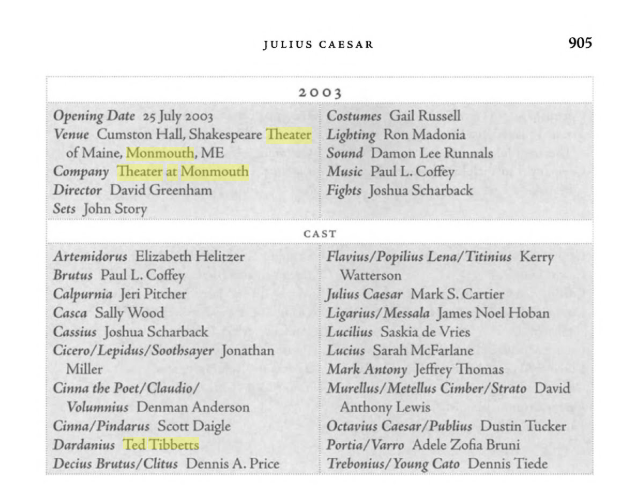
Woohoo! There I am as Dardanius! (Who the heck is Dardanius?!)

I also met the managing director of a local Shakespeare theater who visited my class once.  I asked him if I could audition for a play. (I decided to leave out the details of my last audition.)  He said, “no need, I’ve got a part all picked out for you.” So, I went on to add “Professional Shakespeare Actor” to my resume.  Which really means they paid me $75 for the summer, that didn’t even cover gasoline expenses, to play various tiny roles…that I loved!  I wasn’t in it for just the acting; I wanted to watch professionals prepare. I carried around a notebook, not for my own parts, but to ask the pros how they approached the text.  I added these strategies to my teaching arsenal.

This approach made all the difference.  Students showed up to school 15 minutes early to ask if they could work on their scenes.  I started teaching a Shakespeare through Performance elective. Several students went off to a summer Shakespeare program.  They went to the drama club, then came to me and said, “It was pretty cool, but it wasn’t Shakespeare. What if we had a separate club just dedicated to Shakespeare?”  I thought, “Well, we’d probably have a dozen or so kids, why not?”

We ended up with around 25 students in the club, which turned out to be one of the most powerful student groups with which I’ve worked.  In the fall we worked on skill development, ensemble building, and everyone learned a monologue (including me). In the winter, we cut a play to a 15-minute farce.  In the spring we produced a full-length Shakespeare play and the first week of summer vacation we spend at the Royal Shakespeare Company workshopping with RSC actors during the day and attending the theater at night.  It was truly an incredible experience. We completely took over a Bed and Breakfast in Stratford. One year I had the forethought to buy an extra ticket to the evening shows “just in case,” so I invited Bridget, the B&B owner to join us for the evening.  “That would be lovely,” she said in her proper English accent. “I haven’t had a chance to get out to the theater all season. And” she added with a bit of a twinkle in her eye,” I know where the actors go after the show.”

So off to Comedy of Errors that night.  Then to the Dirty Duck after the show to, hopefully, catch up with some of the actors.  They came in alright, with their friends, and were immediately accosted by my students asking them to sign programs.  Seeming a bit taken aback they politely acquiesced, then returned their attention to their peers.

For better or worse, American high school students are louder than British actors. Loud as they might have been, however, ignorant they were not.  All had covered a Shakespeare play each year in English class. Most had taken the Shakespeare elective which covered four or five plays a semester, and in the club, we had referenced, workshopped or performed several more.  So, forsooth, many of these students could speak knowledgeably about 15 or more plays. Enthusiastically they were connecting the Comedy of Errors to other plays, quoting various lines, talking about their favorite parts of the play and I could see the actors looking over with quizzical glances seeming to say: “Who the hell are these kids?”  Within an hour the actors had ditched their friends and were hanging out with the students talking “shop.” (By the way, this can’t be assessed with a rubric. Can you imagine, though? “Can converse knowledgeably in a pub with an RSC actor about a line from Titus Andronicus…Exceeds the Standard!”)

I have continued to teach Shakespeare this way ever since.  While I have changed schools and no longer direct a Shakespearean acting troupe, I still look forward to…okay, long for, those Shakespeare units.  Admittedly, some of my more introverted students don’t look forward to it as much as me, but many do. And the growth that results from performing Shakespeare rivals any learning experience I witness in school.  (To read my story about MaryAnn, click here!)

If someone like me, who forgot most of their lines in an audition, can use theater strategies to teach Shakespeare, anyone can!  Give it a try, share the experience with your students, rethink the “Complete Works” and put the play back in Shakespeare!

.

Designing Shakespeare Lesson Plans

-Ted Tibbetts

The daunting task of designing an entire unit of Shakespeare lessons can feel like, well….Exit,  pursued by a bear.  While these units hold so much potential, helping students over the Elizabethan language barrier can be tough.  So tough, in fact, it can be tempting to “do you any embassage to the Pigmies, rather than” attempt to convince students that Shakespeare can be fun.  By planning a series of progressive skill building activities, however, you will find that students will clamor for more! Really.

Shakespeare Units:  Backwards Design

When designing Shakespeare units, consider “Backwards Design” if you are a Marzano follower, or “keeping the end in mind” if you are a Covey acolyte. Some teachers may want to emphasize literacy, essential questions, or cultural allusions.  As I have discussed before, I prefer to focus on the performance.  The process fosters teamwork (“I don’t want to play Juliet, you play Juliet-No I don’t want to play Juliet-okay, fine, I’ll play Juliet), and resiliency, (“Gulp, there’s an audience out there”).  I find that textual and cultural literacy will occur de facto, though I usually include few activities to ensure that happens. However, when considering the big picture of what I want my students to know or be able to do: perform a Shakespeare scene.   I consider this the third and final phase of the unit.

To get to phase three, we must deliberately plan phase two.  (For you Monty Python fans, five is “right out.”) . How do I teach students the skills necessary to perform a scene?  For English class students, many who have 1) never acted before and 2) are initially terrified of the process, I like to keep it relatively simple.  Clearly, they need to understand what the words mean and how they feel about what they are saying. They need to be able to “speak the speech…trippingly on the tongue” so it doesn’t sound like a drunken cowboy at a hootenanny.  (No offense to you drunken cowboys out there.) They also need to know how to use space to communicate ideas so they’re not either standing in a line or a circle oblivious to the audience. Finally, they should know how to depict a character.  

Phases of Shakespeare Lesson Planning

BUT, before we can get to any of the skill development, we have to plan phase one.  In many pedagogical circles, educators emphasize the need to clarify misconceptions.  Most importantly, as Shakespeare teachers, we must change the student paradigm that Shakespeare is a boring, pompous dead white guy impossible to understand.  Or, in other words, eliminate “Shakesfeare.” (I usually begin this process by telling them that many of Shakespeare’s original audience couldn’t read and that there or more sex jokes in the opening of Romeo and Juliet then in an entire episode of Game of Thrones.)  Consequently, many of my phase one activities are purposefully upbeat, relatively easy, and, often, as silly as possible.  Making these warm-ups and introductory activities energetic gradually fosters familiarity with the language and hopefully sends the message that, “Hey, this is kind of fun.  Maybe I won’t be eviscerated doing this.” When students come to class and begin asking hopefully, “Are we doing Shakespeare today?” then you know you’ve accomplished the mission.

Time for Shakespeare

We also face the thorny issue of time.  Already pressed for time as a result of this standardized testing day, that professional development day, or, in the North, the inevitably ill-timed snow day, our classroom time disappears faster than happy hour on Friday.  And, for sure, using performance strategies to teach Shakespeare takes time. This is why: I assign almost no homework for this unit. Other than activities at the end of the unit to prepare for scene work, I do it all in class.  In my humble opinion, assigning Shakespeare reading for homework constitutes a recipe for disaster. My entire approach is predicated on the philosophy that Shakespeare should be seen and experienced, not merely read. However, this approach takes time, and curricular demands often necessitate covering more content.  

Thus, I solve this problem by assigning less complicated text…a choice book perhaps, or, in the case of a 9th-grade classroom, The Pearl.  In addition, lately, I have been experimenting with faux online class structures.  As online education becomes more and more popular, (many of our juniors and seniors take online college classes in high school), I want students to be familiar with the process.  Moreover, as a Google Classroom school, it is easy for me to post materials, assignments, and discussion questions online. I check in with students in class each day about this unit to answer any questions, but, for the most part, students complete this work on their own and we can focus on Shakespeare in class.

In addition, I save time by cutting the play.  Bryn Allison in her article “How to Teach Shakespeare so Your Students Won’t Hate It” suggests both omitting entire scenes and performing parts of others. I find this highly effective.  Rather than forcing students to muddle through long passages of archaic references, I streamline scenes to be more time efficient. I often post or print cut google doc versions for class.  (If you think you’d like versions of these scenes, leave a comment below and I’ll add posting them to my project list!)

Lesson Planning

Students work the opening of Romeo and Juliet

Many learning situations, especially activities like music and sports, follow a progression.  First comes the warm-up, then skill building followed by the application of the skills in drills, and finally,  the performance or game. I like to follow a similar daily progression. I choose a warm-up appropriate to the needs of the students and the content of the day.  For example, if students need to develop more reading fluency, I’ll choose a text activity. If their speech sounds like a garbled mess I’ll choose a voice activity like “Silly Sounds.”  If the scene for the day provides opportunities for complex blocking, then we’ll do a space activity. I often consider the warm-up to be a skill builder as well, so we often progress right to the scene(s) of the day.  As mentioned earlier, most of my phase one activities focus on building familiarity. In fact, I often tell students, “Don’t understand any of it; I’ll explain it later!” so they don’t get bogged down. Once students begin to read more fluently and have overcome some of their anxiety about the text, I facilitate more skill-building activities like “Dropping In,” “Find the Breaks,” or “Embedded Stage Directions.”    (Look for upcoming posts on all these activities!)

After warm-ups/skill building, we run the scene.  For phase one and the beginning of phase 2, we do it all together.  I either ask for volunteers for the parts or “highly encourage” students to take on various roles.  Usually I also “set the scene” by explaining generally what happens in the upcoming scene and how the characters feel about what’s going on.

Students then read through the parts on their feet, acting as much as possible, and I play the role of director suggesting ways to deliver the line.  For example, I may ask them, “How do you think the character feels about what you just said?” When they answer I say, “Okay, say it like you mean it.”  Or, I may suggest, “Okay, you really want her attention right? And she’s not so sure she wants it, so…each time to say a line take a step closer. And you, every time you say a line, take a step away.”   I’ll even sometimes have a student deliver a line two or three ways and ask them which one they like best.

For longer scenes, I will find natural breakpoints and recast with different students to get more people involved.  About midway through phase two, I’ll break the scene into parts, and assign a group of students to cast, read, and briefly rehearse their section, then bring the whole class together in a scene jigsaw where each group performs their part of the scene. Not only does this approach get everyone involved but it also prepares them for scene rehearsal.

Shakespeare Assessment

A scene from Merry Wives


I plan on putting together an entirely separate post on assessment; however, I will touch on it here.  Essentially, I tell students to decide what character or scene they would like to perform, or with whom would they prefer to work.  I give them a performance rubric (the rubric addresses the Reading Literature and Speaking and Listening Standards) and a week and a half and…go! I ask them to create basic costumes, obtain necessary props, memorize lines, and rehearse the scene. I try to schedule time in the theater so we have a bigger space in which to work.  

During the phase, I also give small assignments that help them prepare.  I facilitate a memorization tricks workshop. I ask them to “translate” their individual lines into their own language and submit it.  I also have them submit “Intention Notes,” and I give them memorization quizzes for blocks of lines. Many students still feel nervous at this point, so I tell them that if they complete all these assignments to the best of their ability, I guarantee success no matter what the outcome of the performance.

Conclusion

Like most fears, the reluctance to study Shakespeare stems from the unknown. Confidence, on the other hand, comes from accomplishing challenging but manageable tasks.  People don’t often get up from the couch and run a marathon. By sequencing lessons and activities in ways that foster confidence and skill building, teachers can help create Shakespeare enthusiasts from their students.

Please feel free to post questions and comments below!

The Number One Reason I Love Teaching Shakespeare (Way Beyond Standards…)

-Ted Tibbetts

I felt almost giddy in the classroom. Clearly, my students could sense it. I was introducing the Shakespeare unit; I’m sure I was gesticulating wildly, talking fast, and perhaps even foaming at the mouth a bit. Cassius would have disapproved. I paused for a breath and one of my students raised her hand.

“Why do you love teaching Shakespeare so much?”

I felt pretty sure I knew the answer; but I started off with the typical, “It’s good for language skills and cultural knowledge and the human condition and…,” but then I stopped.  And told them a story about MaryAnn.

Afterward, wondering if others felt the same, I did some research.  As it turns out, I agree with the Shakespeare teachers out there. I particularly enjoyed Brian Sztabnik’s article “Why I Love Teaching Shakespeare (And You Should Too!)”  He’s spot on when he says that getting up and acting it creates “less of a sedentary place and more of a dynamic environment for learning.”  I couldn’t agree more that the themes foster “sophisticated discussions.” And he even acknowledges that as a student, reading Shakespeare helped him develop his reading confidence.  I would add that the confidence-building extends beyond reading. In fact, it has had the most significant impact on both me and my students.

Here’s the story….

I began using performance strategies for teaching Shakespeare in the mid-1990s.  The strategies had such positive impacts in English class that they spawned a Shakespeare through Performance elective.  Several students participated in a summer Shakespeare program. Then they came back in the fall, went to drama club, came back to me and said, “Drama club’s cool, but it’s not Shakespeare.  What if we had a separate drama club just for Shakespeare?”

Me (out loud)  “Sounds great!”  Me (inner voice) “With three of you?”

We ended up with around 25 students.

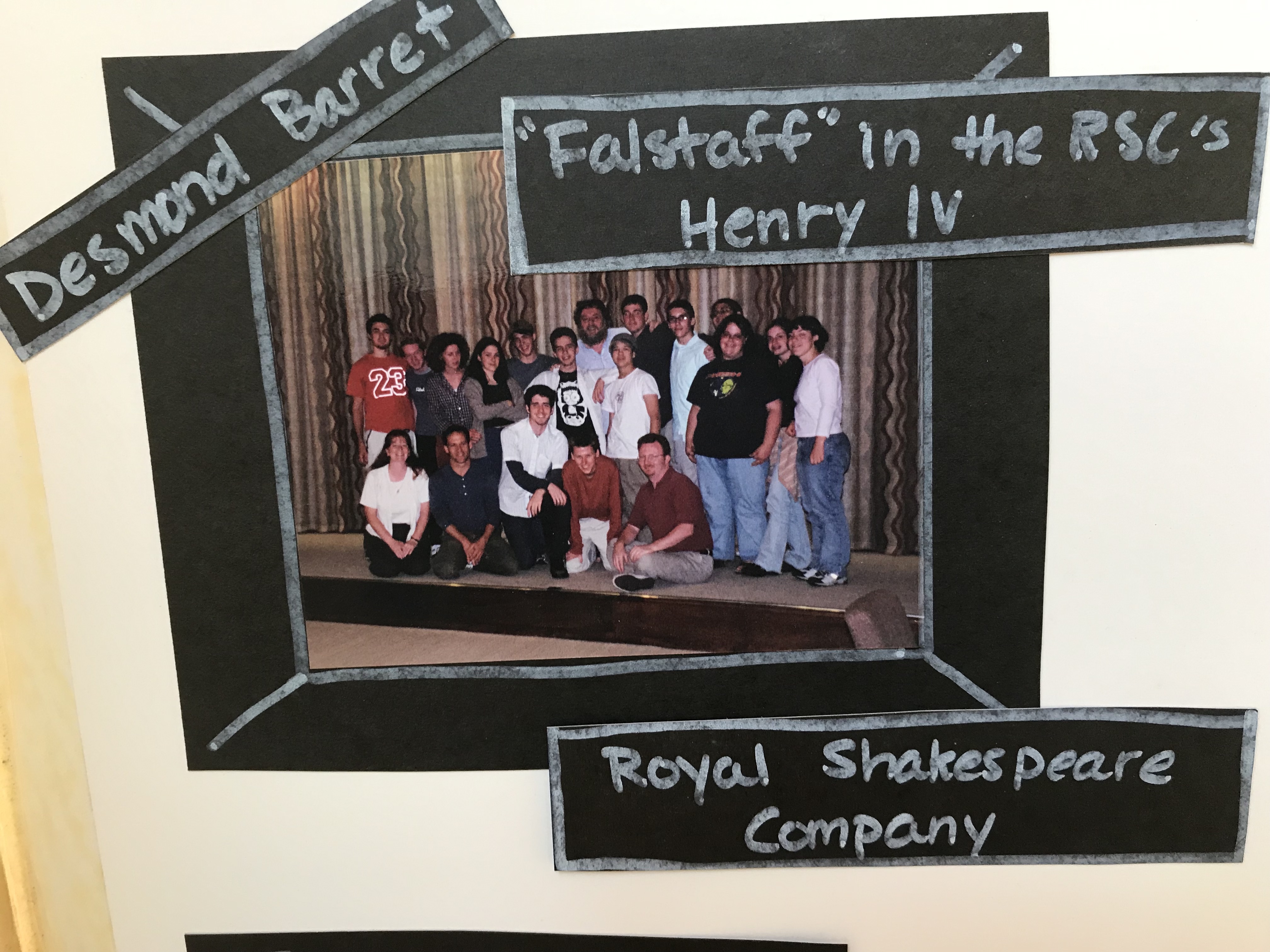
Students workshop with Desmond Barrit of the Royal Shakespeare Company

This club turned out to be one of the most powerful student groups with which I’ve worked.  In the fall we worked on skill development, ensemble building, and everyone learned a monologue (including me).  In the winter, we cut a play to a 15-minute farce. In the spring we produced a full-length Shakespeare play and the first week of summer vacation we spent at the Royal Shakespeare Company workshopping with RSC actors during the day and attending the theater at night.  It was truly an incredible group with which to work.

MaryAnn joined the club her sophomore year.  Often appearing shy and self-conscious, she struggled to decode text. Once the language anchored itself into her head she was fine, but getting words from the page to her head, then into her voice, was an arduous process.    

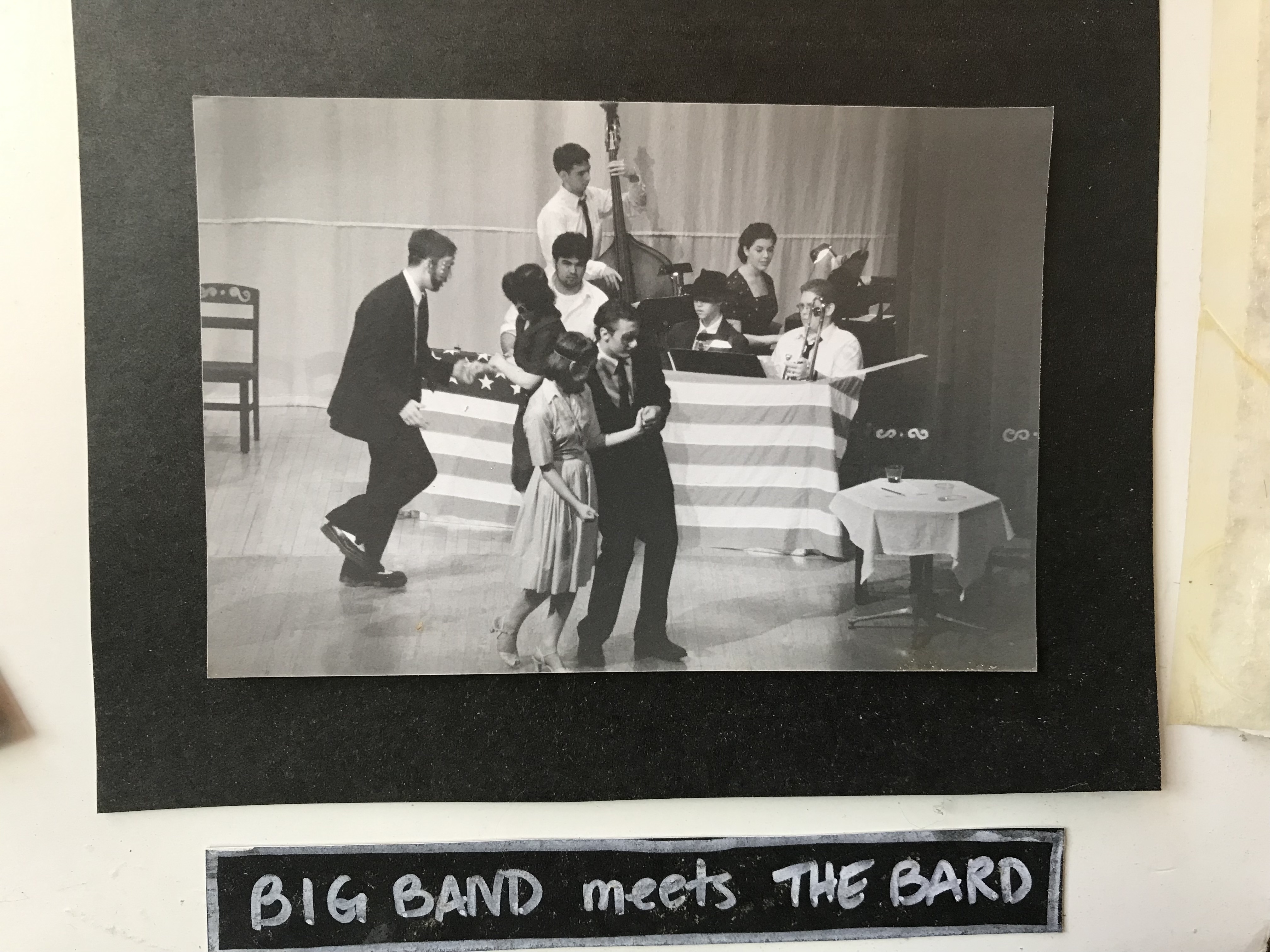
Much Ado Swing Style!

That year we produced Much Ado About Nothing.  It was the year Gap had been running the khakis swing dancing commercials, and since it was a post-war play we decided to set it in a post-WWII swing dancing era.  A local music teacher and composer set “Sigh No More” as a swing song (“Hey! Hey! Nonny Nonny, Hey! Hey! Nonny Nonny”) and “Goddess of the Night” as a slow blues tune. MaryAnn’s singing voice made her an excellent fit for Balthasar.  Her performances were beautiful but restrained. I could tell she still felt a bit hesitant.

Her junior year we did Merry Wives of Windsor.  She played Bardolph, still a small role, but one she took seriously.  Kids told me that she never broke character even backstage. It was also this year that I really began to understand how her brain worked.  She still struggled with reading text, but one day I discovered that she possessed outstanding verbal skills.

We were workshopping monologues in a variation of a “dropping in” exercise.  We’d asked her questions about the words in her text designed to provide her with emotional and visual context for her monologue.  Then, she stood up and performed it for us. When she finished, she just stood there. And I knew that she had gone somewhere…hypnotized almost.  We just sat there and waited. “The words….” she stammered and shook her head almost as if to clear the cobwebs. “The words….”

Then came her senior year.  We had decided to perform Henry IV Part 1.  Students had filled out audition sheets and when I got to hers I saw that she wanted to play Falstaff.  

Oh, boy.

So I called her into my office.

“I see that you want to play Falstaff.”

“Yeah, that would be great!”  

“There’s a lot of lines…a lot of memorization.”

“I know.  I know. But I can do it.  I promise.”

“There’s a lot of jokes about size, and..uh….”

“I know.  But I really want to do it.”

Thinking.  (Me). Waiting.  (Her).

“Alright, Let’s do it.” And so began one of the most powerful educational experiences of my life.

As a teacher or a student.

I liked to structure rehearsals like this:  On Monday we would rehearse a scene: work on the language, determine blocking and create characters.  (Only the actors involved in that scene needed to be there.) Then the next scene on Tuesday, maybe a couple of scenes on Wednesday, and so on.  On the last rehearsal of the week, usually Thursday or Friday, the entire cast would come. We would run the scenes we had already rehearsed word for word.  I expected actors to have memorized their lines for those scenes we had already rehearsed. Then, we would improvise the rest of the play. “Tell me the story,” I would shout from the audience.  I loved this part. A bit rocky at first, but week by week these run-throughs grew more and more comic.

MaryAnn came to her first rehearsals with her lines already memorized.  Not perfect, but pretty darn close. Although we never really talked about it, I’m pretty sure that she knew that it would be tough for her to read them and rehearse, so she prepared early.  And the results were astounding. Free from decoding text she found sight-gags and interpretations that went far beyond my creative abilities.

Indeed, she made good on her promise.  She learned all her lines; she created a strong character.  It turned out to be a highly engaging show with comedy, drama, music, and clanging and banging broadsword stage combat.  Word spread. By our last show, we had a packed house. And MaryAnn truly emerged as a star.

She had decided that Falstaff would ALWAYS have a pint of ale in his hand.  At the inn, on the road, and in battle. Late in the play, during a battle scene, Falstaff feigns death, (after carefully setting his ale down lest he spill a few drops) to avoid risking his life fighting Douglas the terrible Scot.  Meanwhile, on the other side of the stage, Hal, the protagonist succeeds in killing Hotspur the Antagonist. After Hal exits, Falstaff gets up and sees Hotspur lying there (after his “the better part of valor is discretion” speech.)  He decides that Hotspur looks scary even dead, and, lest he “counterfeit too and rise” Falstaff decides to stab him to be sure he IS dead. Moreover, even better, he can claim that Hotspur, merely wounded, rose again and that he, Falstaff, ultimately killed him. Again, MaryAnn made a hilarious interpretive choice here saying “Therefore, Sirrah, with a new wound in your…[closing her eyes and stabbing blindly, then looking]…thigh, come you along with me.”

The stage directions then state that Falstaff “Takes up Hotspur on his back.”  Fortunately for us (I’d love to claim that it was brilliant casting on my part but I don’t recall having the forethought for this), a 112-pound champion wrestler played Hotspur, so his athleticism and MaryAnn’s strength made this move possible.  Not only could she pick him up but she could also retrieve her pint of ale in the other hand. Of course….

Prince Hal and other members of the army of re-enter and question Falstaff about Hotspur’s death.  And then comes the stage direction, “Throwing the body down”, but how could Falstaff put him down without spilling the ale?  Once again, Hotspur’s athleticism came into play. Falstaff could heave him from his shoulder, and Hotspur could use stage combat falling technique to protect himself while making the fall look real.

“He’s dead.”


So, as I said, it’s a full house. Most of the audience hadn’t seen the show yet and have no idea this is coming.  MaryAnn heaves Hostpur from her shoulder who falls with a great clamor on the hardwood stage floor. There is a LOUD audible gasp from the audience. I’m pretty sure I heard multiple “Oh my God!”s. MaryAnn stops…looks at the audience, shrugs her shoulders, points to the body and whispers, “He’s dead.”

Uproarious laughter and a standing ovation on the spot!  And I’m choking because my body can’t decide to laugh or cry.  It’s HILARIOUS but I’m wiping away tears because I am so moved by the moment.  This shy, self-conscious, most likely dyslexic student has internalized Shakespeare and the language.  That’s exactly what Falstaff would have said! She has developed confidence. She’s, for the moment, the hero of the play. And I think, “This is why I teach Shakespeare.”

There is no Common Core standard for that. But it’s the most important. And yes, I fully agree that the rigor of Shakespeare’s texts develop literacy and cultural knowledge and…the list goes on.  But performing Shakespeare, even in low key settings of the classroom help build people, not just students.  Yes, there can be some anxiety.  (Anxiety is today what ADHD was in the 90s).   But our students need opportunities to work on overcoming this anxiety.  In a day where educational leaders and community members chant “Rigor!” studying and performing Shakespeare fits the playbill.

Performing Shakespeare builds community in the classroom.  Students learn to trust each other. They bond by overcoming shared challenges. They clap for each other; I clap for them.

Difficult moments will arise.  At the end of the unit, there’s usually at least one student who says, “I was terrified and never want to do it again.”  Others admit, “I was terrified, but I’m so proud of myself for doing it.” Believe it or not, though, a significant additional portion of students clamor, “That was fun, let’s we do it again!”

At that moment, I’m reminded of MaryAnn. I feel myself tearing up, and my students once again wonder what’s wrong with me.


Silly Sounds: Teaching Shakespeare Voice and Language

Many students initially object to Shakespeare because it sounds funny.  But funny in a bad way. Like, “hmmm, this milk smells funny.” This activity spins funny in a good way.  Like, “that scene from Comedy of Errors sure was funny!”  By using a non-traditional and non-serious approach to the text we can demystify Shakespeare, improve students’ diction, and increase their familiarity with the language.

A Brief Stint into Pedagogical Theory

Before we delve into the activity, we should discuss some pedagogical theory. ( Don’t worry, this won’t be as long and boring as a faculty meeting.)  Learning needs to happen through repetition. However, when repetition gets boring our brains check out so although we think we’re getting repetitions we’re really just wondering what we’ll do when Game of Thrones ends.  Thus, most efficient learning comes when we can engage in experiences similar enough to facilitate learning BUT varied enough to keep in fresh.  (Unlike the funny smelling milk.) That’s one of the reasons I love this activity.

Speak the Speech

All that you need for this activity is some text, a sense of adventure and trusting nature.  Essentially, students will read a text in a variety of ways. I usually place them in pairs and have them switch of reading when they come to a “major punctuation mark” like the end of a sentence, a colon or semi-colon.  That way they can get a bit of a break and, also, listen to someone else reading.

For all of these directions, I usually explain them briefly, then immediately say “Off you go,” then start modeling the directions myself.

First, I tell them to read while waving their hands in “dramatic flourishes.”  This does nothing to improve their reading but it increases the energy. I also have an unscientifically proven theory that this makes them feel more like real Shakespearean actors.  

Next, I tell them to pronounce ONLY the consonant sounds.  After I remind them what a consonant is, I model a line. For example, the line “This thing of darkness I acknowledge mine” would sound like “Thsthngfdrknsscknldgmn.”  It’s like Pig Latin but more chaotic.

Then, you guessed it…vowels.  This gets even sillier. “I have of late but wherefore I know not” sounds like,” I-a-o-a-u-e-o-io-o.”  

After vowels I usually have students vacillate through their vocal range.  The begin a line talking really low like Darth Vader and gradually, over the course of the line talk in a high voice like Michael Jackson, then back down again.

Then I get really crazy.  Sometimes I have them sing…opera, rap, country twang.  Then in an “outrageous accent. Really OUTRAGEOUS.” Some students become a bit hesitant here, but others leap right into it.  There’s usually quite a bit of giggling going on at this point. From the students, too. If so, I know the activity has been a success.

I always end with a whisper.  But I tell them “not to lose a single sound.”  This variation fosters precision in their articulation.  It also helps to restore a bit of order and focus. Chaos can be great but needs to be reigned in before we can shift our focus to scene work.

At the beginning of a Shakespeare unit, I do this activity as a warm up about twice a week.  I see a dramatic improvement in the fluidity of their reading and the clarity of their diction.  Give it a try and be sure to send me a recording of the outrageous accents!

https://youtu.be/5gmXKl4FwCk

Check out some student examples!

Fun Activity for Teaching Shakespeare Plots

Why Teach a Plot Summary?

Teaching Shakespeare can be hard; learning Shakespeare can be even harder.  The demands of vocabulary, syntax, plot, and sheer volume of words can overwhelm young brains accustomed to processing bite-sized text. Student brains can often crash attempting too much too soon with a Shakespearean play. They are like web browsers taxed with too many open tabs. Beginning with a plot overview engages all learners and relieves anxiety while introducing the characters and plot lines; thus, freeing brain power to focus on the complexities of language in future lessons.

“Casting” the Play

To begin, assign as many roles as possible.  I will often write the major characters on scrap pieces of paper or occasionally grab a stack of “Hi, my name is….” stickers from the office. When I have time, a particularly creative burst of energy, or a class that really needs strong visual references, I make large name cards that can be worn around the neck.  I find including smaller characters like servants or messengers unnecessarily complicates the plot lines; however, small parts often engage more reluctant thespians. So I often include parts like, “The bush that Romeo hides behind” or, for Twelfth Night, “The Bow, “The Stern,” “The Mast” and “The Shipwrecking Storm.”

I employ various strategies for distributing roles.  Sometimes, I have students pick parts from a hat. Other times I “rig” the drawing when I know that either someone would serve as a marvelous Mercutio, or, terrified of performing, they would make a terrific tree from which Ariel could be rescued.  In addition, sometimes I try to get everyone a role, or, with smaller classes, two roles, and other times I promise that non-recruited students will receive roles in the future.

Action!

After parts have been cast, read a plot summary.  I like the ones from Shakespeare for Dummies.  They impart a sense of humor and aren’t too detailed…although at times I find myself adding more detail if I think that students are following the plot well.  As I read the summary, students get up and improvise that part. For example, I would read, “Duke Orsino sends letters to Lady Olivia, who rejects them because she is mourning her brother.”  I would then prompt the student playing Orsino, “Hey, send her this letter. [The piece of scrap paper I’m waving around my hand] Give it to that guy, he’s the messenger.” Orsino usually takes the letter and hands it to the other student and direct the messenger:  “Okay, go give it to Olivia over there. Okay, good. Now Olivia…reject it.” At which point, she either puts up her hand, drops the letter on the floor, or, ideally, she rips it up dramatically then hurls it at the messenger. Progress through the summary, reading, directing, encouraging and complimenting.  After finishing, check for understanding. Ask questions for the class to answer, or see how much of the play they could do again without prompting.

Bonus Tip for Creating Culture

Years ago I participated in a Shakespeare workshop with a theater out of Lenox, Massachusetts, and Kevin, the director, gave me some of the most powerful educational advice:  “Don’t be good at it!” I found this liberating. “Wait…I don’t have to be good at this? I can just wing it?” Suddenly my brain and heart were free to fully experience the activity without worrying about getting it right.  Let’s face it, ALL learning is failure. If you didn’t fail, you didn’t learn…you already knew it. Thus, focusing on the experience, not “getting it right” helps create a growth mindset culture.

So give it a try! Post your questions, reactions, and discoveries in the comments! You can check out a video version of this post below!