Teaching the Power of Connotation in Shakespeare

When I was a kid, I loved Wonderbread.  Seems odd now…I think it tastes like paste.  Then again, I liked paste when I was a kid, too.  

Paste and Wonderbread…not really much flavor there.  White, bland, lacking in nuance.

Unlike Shakespeare.  The complexities of language stimulate the eyes, the ears, and the heart.  Like Tim O’Brien says in The Things They Carried, you can feel a true war story with the stomach.

However, without sophisticated language skills, it is impossible to truly experience the full effect of Shakespeare.  It takes a developed palate to appreciate artisan whole grain bread, so we must help students develop an appetite for dense language.

I begin teaching the concept of connotation by drawing a line on the board.  I explain that the line represents a continuum of negative feelings, or connotation, on the left and positive feelings on the right.  Then, right in the middle, I write the word “economical.” Then pick a random student and make up a story.

“We all know that Chad has been working a lot lately.  He’s been saving up for a new truck. Been doing pretty well, too, banked a couple hundred dollars last week.  But, he just started dating this girl, and it’s her birthday, so he has to choose: money for his truck or for a birthday present?  He needs a truck to get to work, but he really likes this girl.

Let’s say we like Chad, and respect his choice to spend $8 on some flowers from the grocery store.  What word would best describe his financial choice? Frugal? Yes, that means responsible with money.  Now let’s pretend that we’re jealous. We like the girl and would spend more money to really demonstrate our affections.  How would we describe Chad then? Cheap? A Tightwad? Absolutely.

See how the three words mean essentially the same: conservative with money.  However, they carry different emotional meanings, or connotations, which reveal tone…how the writer or speaker feels.  ‘Frugal’ shows that we respect Chad. ‘Cheap’ reveals that we despise him. ”

That’s my introduction. I will then reinforce the concept with another triad of similar words, skinny, thin, and slender, perhaps, or sluggish, slow, and leisurely.  

…a ray of sunshine

Many times I will transition this lesson directly into one about similes and metaphors.  I make the point to students that when invoking a comparison, a writer invokes the emotional value of that object.  For example, the metaphor “Catherine is a ray of sunshine in her father’s life” conjures the positive aspects of sunshine: warmth and brightness.  Or, on the other hand, the indirect metaphor, “Catherine slithered into the room” invokes the negative connotations of a snake: deceitful, venomous, and evil.  

Once students understand how specific word choices reveal tone, we can begin exploring how Shakespeare employs this concept.  I find that, at first, when many students read Shakespeare I feel like I’m eating Wonderbread again. There’s hardly any inflection, little emotion, and, even in a performance setting, no facial expression or body language.  In these situations, students have not had an opportunity to connect with the text.
Dropping in…

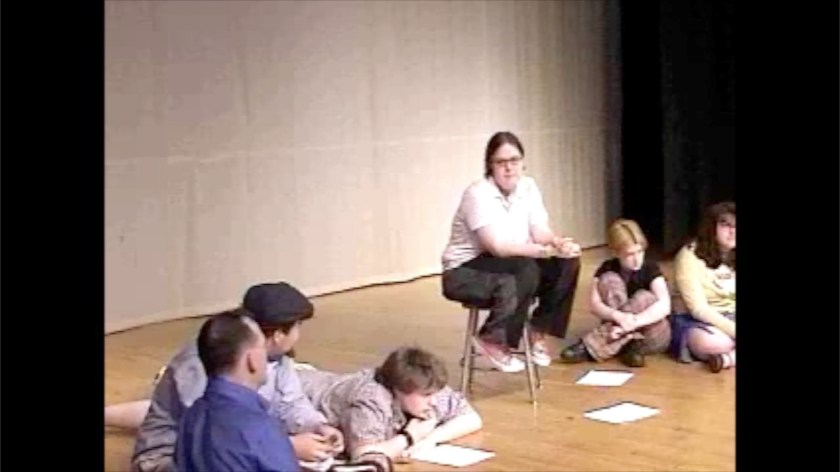
This process, however, provides a chance to relate the language to their memories and prior knowledge.  It’s based on this activity from Shakespeare and Company called “Dropping In.”  However, I use a variation that, quite frankly, I can’t remember how much came from the workshop that I attended, additional reading, or adaptation over time.  But anyway, it goes like this:

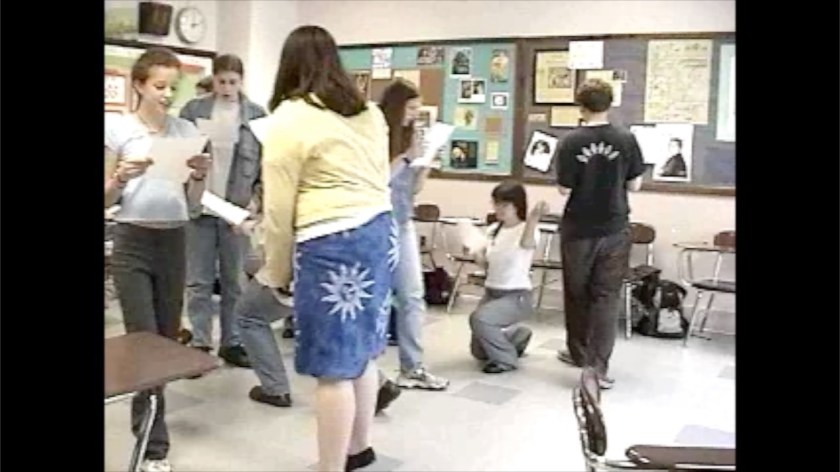
I put students in groups of four and give them a section of text that contains connotation laden language.  I ask them to read through the passage and make a list of the powerful words. After each group has selected their words, I model the following process then ask each group to continue on their own.

Each student takes a turn in the “hot-seat.”   They don’t have to do anything but think and point.  The group chooses a word from the list on which to focus.  Then they take turns asking the hot-seat student a question about that word.  When they formulate a question, they raise their hand. When the hot-seat student points at them, they may ask the question.  The hot-seat students don’t answer, they simply think about their response. During that time, the other group members think of other questions and raise their hands.  It is important that group members raise their hands. If they blurt out questions before the hot-seat student has had an opportunity to process the previous question, then the opportunity to “form bonds” with that word has been lost.

Let’s consider, for example, the word “rage.”  I might ask:

When’s the last time you felt rage?
Have you ever caused someone else to feel rage?
Does rage build slowly or come in a flash?
Where in the body does rage live?
If one particular animal symbolized rage, what would it be?
If you wanted to communicate rage with a musical instrument, which one would
you use?

I tell students to ask as many questions as they can.  When they begin running out of questions, move on to the next word.  If I have an actor working on a particular speech, I leave that person in the hot-seat.  If we are doing classwork, I rotate each group member through the hot-seat with each new word.  I find that although being in the hot-seat intensifies the experience, all group members receive the benefit of internalizing the questions.

After the groups have covered their list of words, or after a set amount of time, whichever best meets the needs of the lesson or class, I have each student stand with a copy of the text, and recite the passage, out loud, to the wall.  (Or, if I’m in the theater I have them perform it out to “the space.” If I have them face the middle of the room they become distracted looking at each other and do not fully engage with the text.) Then we discuss as a class, “how did you find reading the passage at the end as opposed to the beginning?”  Inevitably, students say that not only did the passage make more sense but it also seemed to resonate much more…they were better able to see and feel the images.
MaryAnn as Falstaff

One of my most powerful experiences with this activity came from working with MaryAnne.  As a student, she struggled with the decoding of text but performed well once she embedded the language into her head.  She was working on a monologue from Comedy of Errors.  She had picked out her list of words and several of her cast mates and I sat on the stage asking her questions.  

After we had finished, she stood up and performed the monologue for us.  The words seemed to resonate from somewhere deep. They carried tone, color, and nuance.  We could hear and see the connotation of all the power words. And she, too, seemed to be carried off somewhere.  When she finished, she just stood there. We just sat there, not just rapt in the performance but aware that we were witnessing someone fully experiencing Shakespeare.  I remember her shaking her head, blinking her eyes several times and saying, “the words…the words.” I truly believe that she had, in some manner, hypnotized herself with the language.

On the other end of the spectrum, I find that some classes need me to help them maintain an academic environment.  There’s a fine line between having fun with some silly questions and not taking the activity seriously Other students may need help them come up with questions. , so be prepared to help focus some groups and help create questions.  Perhaps even a reference sheet with questions like “When was the last time you felt______?” “What’s your strongest memory of__________?” would be useful for struggling students.

So much of the artistry in Shakespeare comes from his word choices.  His working vocabulary of 50,000 words, however, often overwhelms students with developing verbal palates. Teach them to chew, however, and really savor the subtle flavors of each morsel, and they will never go back to Wonderbread.
How to Teach Long Shakespeare Passages by Engaging Your Students

Teachers may often feel that their students’ attention span wouldn’t “clog the foot of a flea.”  However, survey results from Prezi suggest they attention spans are not shrinking but evolving.  According to this study, people’s attention “can be captured for long periods of time…, “ however, it must be “with compelling content that includes great stories and interesting, gripping visuals.”  

Consequently, long Shakespeare passages can present challenges in the classroom.  The compelling content may tell great stories, but unless the teacher has fostered the students’ ability to create their own mental “gripping visuals,” the only visuals students will see live inside their eyelids.

You could assign longer passages for homework with some sort of analysis or questions, but I wouldn’t exactly call it an interactive or dynamic activity.  Plus it doesn’t address the issue of making it visual. More importantly, experiencing these great stories with the heart and the body make learning Shakespeare more powerful and more memorable.

So how do we teach it?  One student reading and others listening?  Small group discussions? Whole class discussion?  These approaches still don’t create “interesting, gripping visuals.”

This activity captures the text, involves many participants, and creates memorable visual stimuli that not only fosters emotional response but also anchors ideas in memory. I call it “Monologue Puppeteer” because the teacher serves as the puppeteer directing students to act out the images of the passage.  I often approach this activity in one of two ways.

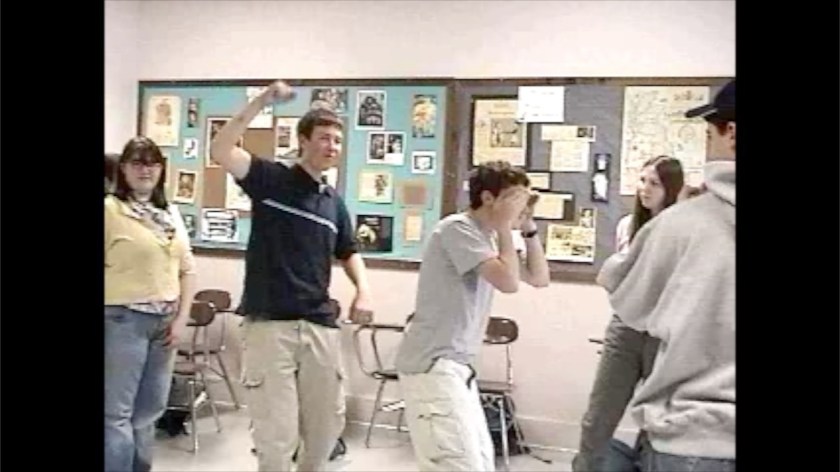
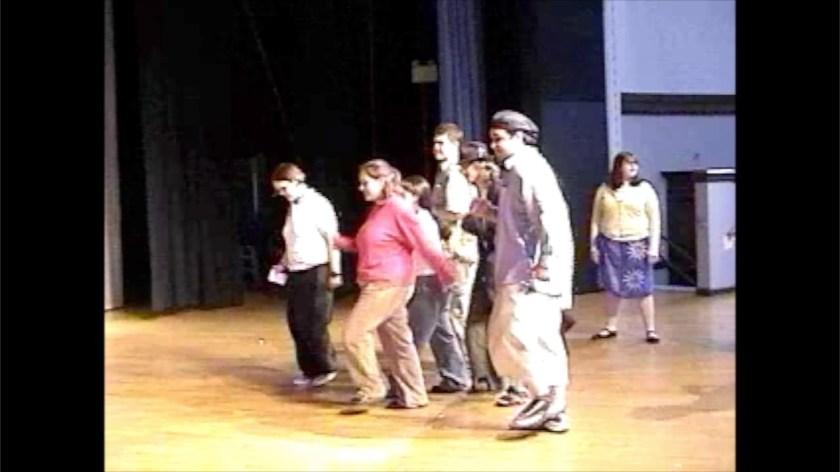
Let’s say, for example, you’re teaching The Tempest and need to cover Prospero’s 17 ½ hour speech.  (Shakespeare knew it was so long that he kept Prospero saying to Miranda, “Dost thou attend me?”)  Here, the speech functions as exposition. Prospero and Miranda don’t need to experience the images.  Prospero has already lived them, so he just needs to communicate information to Miranda. Thus, I have two students read these parts. (I make sure that I choose a fluid reader for Prospero!)  As the students read the parts, I interrupt them and direct the other students in the class to act out the narrative. When Prospero tells Miranda “My brother…I loved and to him put / the manage of my estate” I tell another student, “go be the brother and manage his estate…whatever that means to you.”  Then that student gets up and does some managy things. (He may need some encouragement and suggestion at first, but students get better at it.) Then as Prospero describes how Antonio can “grant suits” and awaken “an evil nature,” I direct the student playing Antonio to act out these images. Then add in an Alonso and Gonzalo, all miming parts read by Prospero. I usually add students to be the younger Prospero and Miranda, the boat, the library, garments and linens to get more people involved. By hearing, seeing, acting the images, the language becomes more memorable.

Other times, I want to emphasize the emotional impact.  For example, in Juliet’s “My dismal scene I needs must act alone” speech, she contemplates the possibilities of drinking the potion.  In order for her to focus on the experience instead of the written text, I have her stand. And another student, standing behind her, reads the part.  As this student reads, I direct other students to act out the images. Juliet can watch the dagger, “lie thou there,” feel the “faint cold fear” that thrills along her bones, smell the “loathsome smells,” (It’s always fun to tell a student, “go be a loathsome smell.”) and hear the “shrieks like mandrakes.”  The student playing Juliet inevitably feels claustrophobic by the end of the monologue.  Even more uncanny, EVERY time I’ve done this activity with a group, I can point to any student and say, “what was he or she?” and the rest of the class can tell me exactly what image they portrayed.  Even coming back to class two days later I can ask, “What did Juliet imagine before she drank the potion?” and recall nears 100 percent.

This activity can also be an engaging way to introduce Shakespeare plays.  I always begin a unit by assigning parts, reading a summary and guiding students through the entire plot.  Doing this before we begin helps them from becoming lost in the storyline as we progress through the unit. I omit servants and minor characters to simplify the plot but direct students to be the boat that sinks or the bush that Romeo hides behind to create more visual images and increase engagement.  I also use it to review tricky parts of non-Shakespearean texts. Acting out the Boo Radley, Bob Ewell, Jem and Scout fracas under the oak tree clarifies the confusion about who had what knife.

Students Act out Richard’s Army

Engagement has emerged as a new buzzword in education over the last few years, and with good reason.  It facilitates learning. And as our attention spans change, these strategies increase that engagement and create “interesting, gripping visuals” that provide opportunities for students get out of their seats and experience Shakespeare (and other texts!) visually, emotionally, and kinesthetically.

Teaching Shakespeare’s Wordplay in Romeo and Juliet

You have reviewed puns, shown examples, and discussed why they’re funny.  Activate Prior Knowledge? Check! You begin the opening scene to Romeo and Juliet and model raucous laughter at the appropriate (and inappropriate) parts.  And yet the students still look at you like you’ve sniffed too much glue. Then you realize…they’re right.  These old references just aren’t that funny to modern audiences. Throw a couple of pool noodles into the mix, however,  and you can transform archaic language into uproarious comedy.

More Matter, Less Art…

After you’ve done your due diligence by explaining puns, hand out a copy of the Sampson and Gregory in Act 1 Scene 1. (You can download a blank copy here, and a completed one here.)  Tell students to look for similar-looking words that could indicate a pun. They should then circle the punning word and draw an arrow back to the word it puns against.  For example:

I model the first three lines with class; then students work through the rest of the passage with a partner.  After they have identified the puns, we complete a little formative assessment and review their choices. “Back in the day,” as my students love to say, I used this almost-as-archaic-as-the-puns-themselves device known as an overhead projector.  Using a dry erase marker to draw circles and arrows (“And a paragraph on the back explaining what each one was to be used as evidence against us!” Sorry…couldn’t resist.) I explained each line. These days, I usually project my screen and simply highlight the puns as students follow along and make adjustments as necessary.  With a tablet, I’m sure you could upload the text and then use a drawing app as a visual reference for students.

Before getting too deep into this activity, I also consider my audience.  The puns at line 20 become sexual as Sampson and Gregory take bawdy stabs at each other.  Gregory, with stereotypical male swagger, claims that he will “cut off the heads of the maids…Take it in what sense thou wilt.”  Sampson, belittling Gregory’s male equipage, responds, “They must take it in sense that feel it.” Not to be put down, Sampson maintains that  “me they shall feel when I am able to stand.”

It is up to the teacher’s style, community attitude, and student maturity how, or if to deal with this subject matter.  When I workshop this scene with middle schoolers, I cut this part out. Most of my high school students get the jokes themselves when I simply explain that these jokes refer to virginity and “the apparent state and size of a part of male anatomy.”  Attention is usually rapt at this point.

Suit the Action to the Word

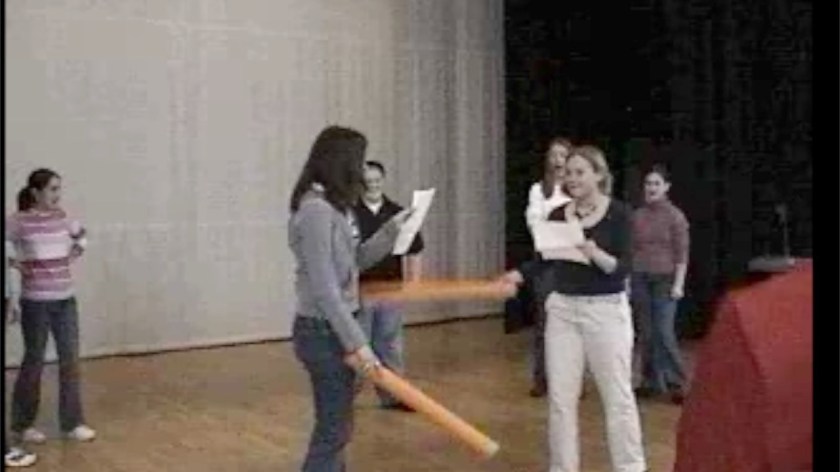
Then I pull out the nerf noodles.  Waving them around usually ensures a rapid and enthusiastic mustering of willing participants.  I choose two students to read and tell the rest of the class that they must help act it out. I give the readers the noodles and tell them that whenever they come to a circled word that has an arrow pointed back to the other character’s word, they get to whack them with the noodle  The only two places they can hit them, though, are the shoulder and the hip. (With some high school boys, especially, we’d have to begin concussion protocol if they were allowed to hit each other in the head!) Also, I remind them that they are friends and not enemies. This is a verbal joust for fun, not mortal combat.  (That comes later!)

In order to emphasize the playfulness of the text, I set the scene.  I tell students to imagine that they have just finished lunch and are hanging around waiting until it’s time to go back to class or work.  Sampson and Gregory have started talking and making jokes at each other. At each palpable hit, the audience students must laugh uproariously, even if it isn’t overly funny.  This helps set up not only the mood of the scene but also provides something for Sampson and Gregory to play off. Furthermore, their participation invites engagement from everyone and not just the readers.

Then off we go!  Sometimes I have to encourage more reticent students to increase the enthusiasm of their laughing, but suddenly, dull, boring and archaic language becomes engaging.  Many times, too, Sampson and Gregory start playing to the audience, pausing for dramatic effect, and taking bows. The energy from the audience pushes them to a point where they can simply react as opposed to worry about how to act.

Then we get to the brawl, but that’s a subject for another post….

Our Revels Are Now Ended

After completing the scene I like to discuss its impact.  How did students like the activity? What mood did the scene generate?  Why does Shakespeare open the play like this? Students often present insightful ideas here and debriefing the experience often solidifies the idea that “Hey, this Shakespeare unit might be fun after all!”

Although I love opening Romeo and Juliet with this activity, it can be effective for other Shakespearean word-play situations as well. For example, I often use it for Beatrice and Benedick, in Much Ado, Falstaff in and Hal in Henry IV Part 1, Lorenzo and Lancelot Gobbo in Merchant of Venice or Feste in Twelfth Night.  I love it because of its balance.  The close textual reading requires students to really grapple with sophisticated language, however, they discover the rewards in a fun, engaging, visceral and visual experience to truly solidify their learning.


So break out those pool noodles!  By beginning the Romeo and Juliet unit with a “15 Minute” play activity, then further engage them with the wordplay of this scene, your students will come to class the next day and excitedly ask, “Are we doing Shakespeare today?”

3 Dynamic Strategies for Teaching Shakespeare’s Language

If you’ve never seen comedian John Branyan’s “Three Little Pigs” Shakespeare style, go watch it now.  It’s hilarious. I’ll wait.

Still laughing?  (I loved it so much I memorized it as a monologue.)  But he’s right: Shakespeare used over 30,000 words in his writing.  While researchers suggest that modern audiences use more than the 3000 words suggested by Branyan, many teachers can identify with his line “‘What light through yonder window…’ What?  Does this come on a DVD?”

In order to convince students that Shakespeare can be fun, we must first show them that the language can be accessible.  (Hey, a significant portion of Shakespeare’s original audience couldn’t even read!)

I use variations of the following activities to accomplish simple goals.  First, I want to foster familiarity. In other words, provide enough repetitions in speaking and listening so that the language starts to hear and feel “normal.”  Second, I want to build voice skills of accurately reproducing the phonetic sounds as well as the proper phrasing. And I want to do this in ways that engage all students.

The structure of the Language

Students are not used to reading text in verse format.  Thus, the inevitable pauses they place at the end of every line, needed or not, distort the rhythm and parsing of meaning.  To help them, I use an activity called “Text Surfing.”

I say a sentence containing a list separated by commas.  Something like, “This weekend I’m going on a canoe trip so I need to remember my paddle, my PFD, my canoe, and my splash gear.”  Then I ask the students: when I finished saying “paddle,” how did you know that I wasn’t done my list? After several smart-alecky answers, we get to the truth of that matter that my voice inflection stays high, whereas, after “splash gear,” my voice inflection goes down.  

Then I write the sentence on the board and illustrate my rising inflection by making a swooping motion up with my hand at each comma.  I direct the students to follow along with me.

After introducing the concept I break out the Shakespeare text.  I tell students to read it while paying attention to the punctuation.  At everything except a period or exclamation point, they should raise the inflection of their voice and, for emphasis, make the swooping motion with their hand.  I will sometimes pair them up and have them switch at every complete sentence if I feel they need some social interaction. I have them read for five minutes or so, circulating around the room and reminding them to “keep swooping!”

I tell them not to worry about meaning at all.  In fact, I don’t care if they “understand a single word!”  I simply want them to pay attention to the phrasing.

I like this activity for its simplicity.  Rather than overwhelming students with complex meanings early in the unit, I focus on building success and familiarity one phrase at a time.

I call the second activity “Traveling Passage.”  Similar to “Text Surfing” this activity focuses on the phrasing of the language.  It adds, however, another layer of complexity. In addition, I like it because I can add movement.  In this activity, I ask students to walk around the room while reading a selection of text. (Verse works better than prose.)  When they come to a comma, change direction. When they come to a period, stop. When they come to an exclamation point, jump. When they come to a question mark, kneel.  When they come to a semicolon or colon, shuffle their feet.

This can become a bit chaotic especially with a larger class in a small space.  Embrace the chaos! The point is not to think about the theological ramifications of killing Claudius while he prays but rather to increase familiarity with the language and, hopefully, teach neophyte Shakespeareans not to stop at the end of every line.  Understanding the nuances of meaning will come later!

Sometimes I find reducing Shakespeare to the ridiculous provides a wonderful catalyst for shattering student illusions that studying Shakespeare should be reverential and plodding.  The language concept of inversion often contributes to this notion. Placing the subject and verb at the end of the sentence just sounds weird. Until you justify it by saying that Yoda does it all the time.  For example, “When nine hundred years old you reach, look as good you will not.”  If I have several Star Wars fans in class, I ask them to quote their favorite Yoda lines with inversion.  

Then comes “Inversion Improv!” I ask for three students volunteers.  I give them a situation like, “You’re on your way to a concert but got a flat tire,” and two minutes to improvise a scene where they introduce and solve the problem…while speaking in inversion the entire time.  While it can be a challenge for some students, this activity has a huge upside: it’s funny, it’s dynamic and interactive, and it provides an opportunity to illustrate a component fo Shakespeare’s language and make it more understandable.

Language study does not have to be boring.  In fact, it definitely shouldn’t be early in the unit.  We can get more in-depth as we progress through the play.  However, by using these hands-on, kinesthetic, and auditory activities, teachers can provide the scaffolding for more complex learning.

Designing Shakespeare Lesson Plans

-Ted Tibbetts

The daunting task of designing an entire unit of Shakespeare lessons can feel like, well….Exit,  pursued by a bear.  While these units hold so much potential, helping students over the Elizabethan language barrier can be tough.  So tough, in fact, it can be tempting to “do you any embassage to the Pigmies, rather than” attempt to convince students that Shakespeare can be fun.  By planning a series of progressive skill building activities, however, you will find that students will clamor for more! Really.

Shakespeare Units:  Backwards Design

When designing Shakespeare units, consider “Backwards Design” if you are a Marzano follower, or “keeping the end in mind” if you are a Covey acolyte. Some teachers may want to emphasize literacy, essential questions, or cultural allusions.  As I have discussed before, I prefer to focus on the performance.  The process fosters teamwork (“I don’t want to play Juliet, you play Juliet-No I don’t want to play Juliet-okay, fine, I’ll play Juliet), and resiliency, (“Gulp, there’s an audience out there”).  I find that textual and cultural literacy will occur de facto, though I usually include few activities to ensure that happens. However, when considering the big picture of what I want my students to know or be able to do: perform a Shakespeare scene.   I consider this the third and final phase of the unit.

To get to phase three, we must deliberately plan phase two.  (For you Monty Python fans, five is “right out.”) . How do I teach students the skills necessary to perform a scene?  For English class students, many who have 1) never acted before and 2) are initially terrified of the process, I like to keep it relatively simple.  Clearly, they need to understand what the words mean and how they feel about what they are saying. They need to be able to “speak the speech…trippingly on the tongue” so it doesn’t sound like a drunken cowboy at a hootenanny.  (No offense to you drunken cowboys out there.) They also need to know how to use space to communicate ideas so they’re not either standing in a line or a circle oblivious to the audience. Finally, they should know how to depict a character.  

Phases of Shakespeare Lesson Planning

BUT, before we can get to any of the skill development, we have to plan phase one.  In many pedagogical circles, educators emphasize the need to clarify misconceptions.  Most importantly, as Shakespeare teachers, we must change the student paradigm that Shakespeare is a boring, pompous dead white guy impossible to understand.  Or, in other words, eliminate “Shakesfeare.” (I usually begin this process by telling them that many of Shakespeare’s original audience couldn’t read and that there or more sex jokes in the opening of Romeo and Juliet then in an entire episode of Game of Thrones.)  Consequently, many of my phase one activities are purposefully upbeat, relatively easy, and, often, as silly as possible.  Making these warm-ups and introductory activities energetic gradually fosters familiarity with the language and hopefully sends the message that, “Hey, this is kind of fun.  Maybe I won’t be eviscerated doing this.” When students come to class and begin asking hopefully, “Are we doing Shakespeare today?” then you know you’ve accomplished the mission.

Time for Shakespeare

We also face the thorny issue of time.  Already pressed for time as a result of this standardized testing day, that professional development day, or, in the North, the inevitably ill-timed snow day, our classroom time disappears faster than happy hour on Friday.  And, for sure, using performance strategies to teach Shakespeare takes time. This is why: I assign almost no homework for this unit. Other than activities at the end of the unit to prepare for scene work, I do it all in class.  In my humble opinion, assigning Shakespeare reading for homework constitutes a recipe for disaster. My entire approach is predicated on the philosophy that Shakespeare should be seen and experienced, not merely read. However, this approach takes time, and curricular demands often necessitate covering more content.  

Thus, I solve this problem by assigning less complicated text…a choice book perhaps, or, in the case of a 9th-grade classroom, The Pearl.  In addition, lately, I have been experimenting with faux online class structures.  As online education becomes more and more popular, (many of our juniors and seniors take online college classes in high school), I want students to be familiar with the process.  Moreover, as a Google Classroom school, it is easy for me to post materials, assignments, and discussion questions online. I check in with students in class each day about this unit to answer any questions, but, for the most part, students complete this work on their own and we can focus on Shakespeare in class.

In addition, I save time by cutting the play.  Bryn Allison in her article “How to Teach Shakespeare so Your Students Won’t Hate It” suggests both omitting entire scenes and performing parts of others. I find this highly effective.  Rather than forcing students to muddle through long passages of archaic references, I streamline scenes to be more time efficient. I often post or print cut google doc versions for class.  (If you think you’d like versions of these scenes, leave a comment below and I’ll add posting them to my project list!)

Lesson Planning

Students work the opening of Romeo and Juliet

Many learning situations, especially activities like music and sports, follow a progression.  First comes the warm-up, then skill building followed by the application of the skills in drills, and finally,  the performance or game. I like to follow a similar daily progression. I choose a warm-up appropriate to the needs of the students and the content of the day.  For example, if students need to develop more reading fluency, I’ll choose a text activity. If their speech sounds like a garbled mess I’ll choose a voice activity like “Silly Sounds.”  If the scene for the day provides opportunities for complex blocking, then we’ll do a space activity. I often consider the warm-up to be a skill builder as well, so we often progress right to the scene(s) of the day.  As mentioned earlier, most of my phase one activities focus on building familiarity. In fact, I often tell students, “Don’t understand any of it; I’ll explain it later!” so they don’t get bogged down. Once students begin to read more fluently and have overcome some of their anxiety about the text, I facilitate more skill-building activities like “Dropping In,” “Find the Breaks,” or “Embedded Stage Directions.”    (Look for upcoming posts on all these activities!)

After warm-ups/skill building, we run the scene.  For phase one and the beginning of phase 2, we do it all together.  I either ask for volunteers for the parts or “highly encourage” students to take on various roles.  Usually I also “set the scene” by explaining generally what happens in the upcoming scene and how the characters feel about what’s going on.

Students then read through the parts on their feet, acting as much as possible, and I play the role of director suggesting ways to deliver the line.  For example, I may ask them, “How do you think the character feels about what you just said?” When they answer I say, “Okay, say it like you mean it.”  Or, I may suggest, “Okay, you really want her attention right? And she’s not so sure she wants it, so…each time to say a line take a step closer. And you, every time you say a line, take a step away.”   I’ll even sometimes have a student deliver a line two or three ways and ask them which one they like best.

For longer scenes, I will find natural breakpoints and recast with different students to get more people involved.  About midway through phase two, I’ll break the scene into parts, and assign a group of students to cast, read, and briefly rehearse their section, then bring the whole class together in a scene jigsaw where each group performs their part of the scene. Not only does this approach get everyone involved but it also prepares them for scene rehearsal.

Shakespeare Assessment

A scene from Merry Wives


I plan on putting together an entirely separate post on assessment; however, I will touch on it here.  Essentially, I tell students to decide what character or scene they would like to perform, or with whom would they prefer to work.  I give them a performance rubric (the rubric addresses the Reading Literature and Speaking and Listening Standards) and a week and a half and…go! I ask them to create basic costumes, obtain necessary props, memorize lines, and rehearse the scene. I try to schedule time in the theater so we have a bigger space in which to work.  

During the phase, I also give small assignments that help them prepare.  I facilitate a memorization tricks workshop. I ask them to “translate” their individual lines into their own language and submit it.  I also have them submit “Intention Notes,” and I give them memorization quizzes for blocks of lines. Many students still feel nervous at this point, so I tell them that if they complete all these assignments to the best of their ability, I guarantee success no matter what the outcome of the performance.

Conclusion

Like most fears, the reluctance to study Shakespeare stems from the unknown. Confidence, on the other hand, comes from accomplishing challenging but manageable tasks.  People don’t often get up from the couch and run a marathon. By sequencing lessons and activities in ways that foster confidence and skill building, teachers can help create Shakespeare enthusiasts from their students.

Please feel free to post questions and comments below!

The Number One Reason I Love Teaching Shakespeare (Way Beyond Standards…)

-Ted Tibbetts

I felt almost giddy in the classroom. Clearly, my students could sense it. I was introducing the Shakespeare unit; I’m sure I was gesticulating wildly, talking fast, and perhaps even foaming at the mouth a bit. Cassius would have disapproved. I paused for a breath and one of my students raised her hand.

“Why do you love teaching Shakespeare so much?”

I felt pretty sure I knew the answer; but I started off with the typical, “It’s good for language skills and cultural knowledge and the human condition and…,” but then I stopped.  And told them a story about MaryAnn.

Afterward, wondering if others felt the same, I did some research.  As it turns out, I agree with the Shakespeare teachers out there. I particularly enjoyed Brian Sztabnik’s article “Why I Love Teaching Shakespeare (And You Should Too!)”  He’s spot on when he says that getting up and acting it creates “less of a sedentary place and more of a dynamic environment for learning.”  I couldn’t agree more that the themes foster “sophisticated discussions.” And he even acknowledges that as a student, reading Shakespeare helped him develop his reading confidence.  I would add that the confidence-building extends beyond reading. In fact, it has had the most significant impact on both me and my students.

Here’s the story….

I began using performance strategies for teaching Shakespeare in the mid-1990s.  The strategies had such positive impacts in English class that they spawned a Shakespeare through Performance elective.  Several students participated in a summer Shakespeare program. Then they came back in the fall, went to drama club, came back to me and said, “Drama club’s cool, but it’s not Shakespeare.  What if we had a separate drama club just for Shakespeare?”

Me (out loud)  “Sounds great!”  Me (inner voice) “With three of you?”

We ended up with around 25 students.

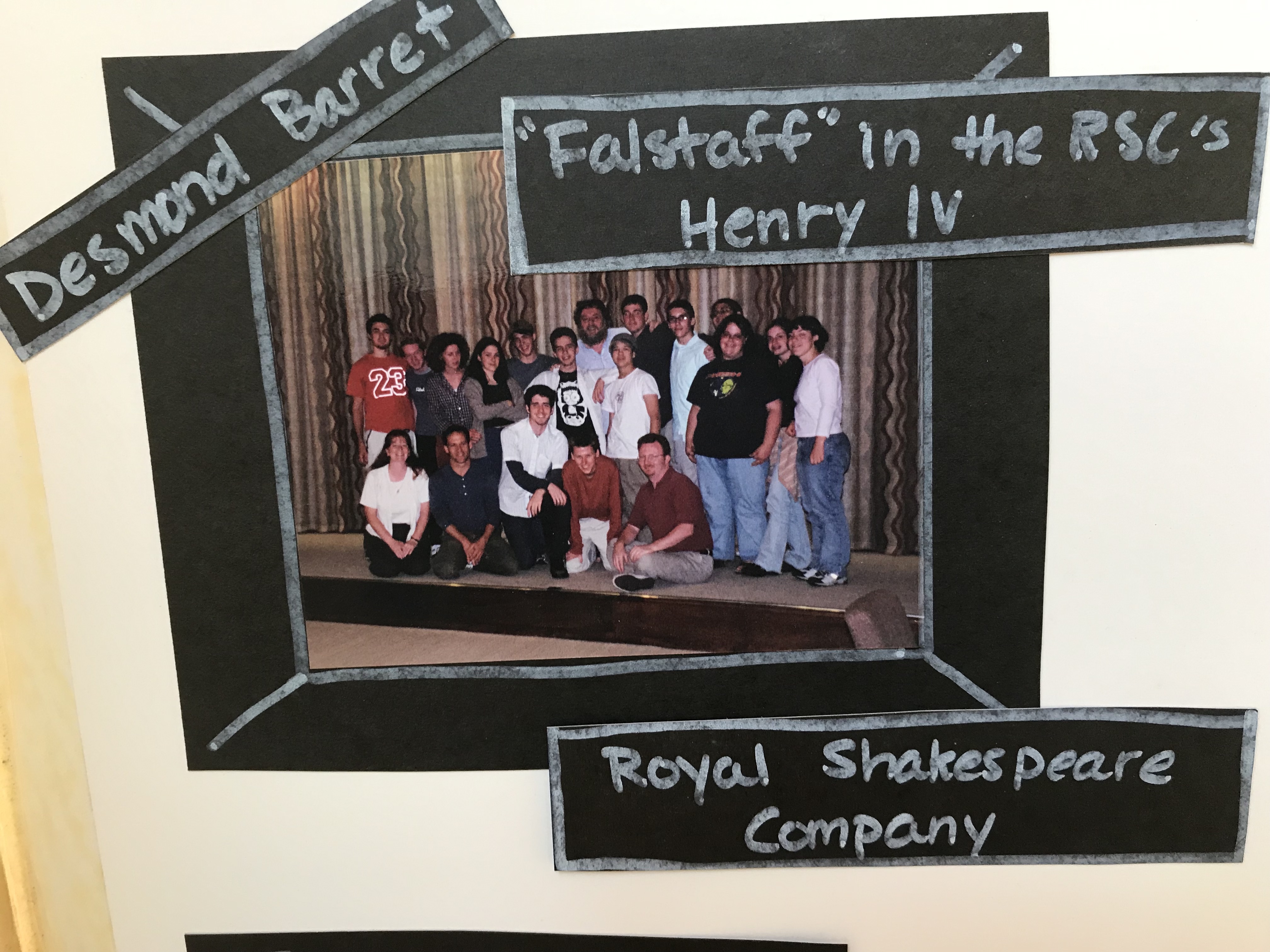
Students workshop with Desmond Barrit of the Royal Shakespeare Company

This club turned out to be one of the most powerful student groups with which I’ve worked.  In the fall we worked on skill development, ensemble building, and everyone learned a monologue (including me).  In the winter, we cut a play to a 15-minute farce. In the spring we produced a full-length Shakespeare play and the first week of summer vacation we spent at the Royal Shakespeare Company workshopping with RSC actors during the day and attending the theater at night.  It was truly an incredible group with which to work.

MaryAnn joined the club her sophomore year.  Often appearing shy and self-conscious, she struggled to decode text. Once the language anchored itself into her head she was fine, but getting words from the page to her head, then into her voice, was an arduous process.    

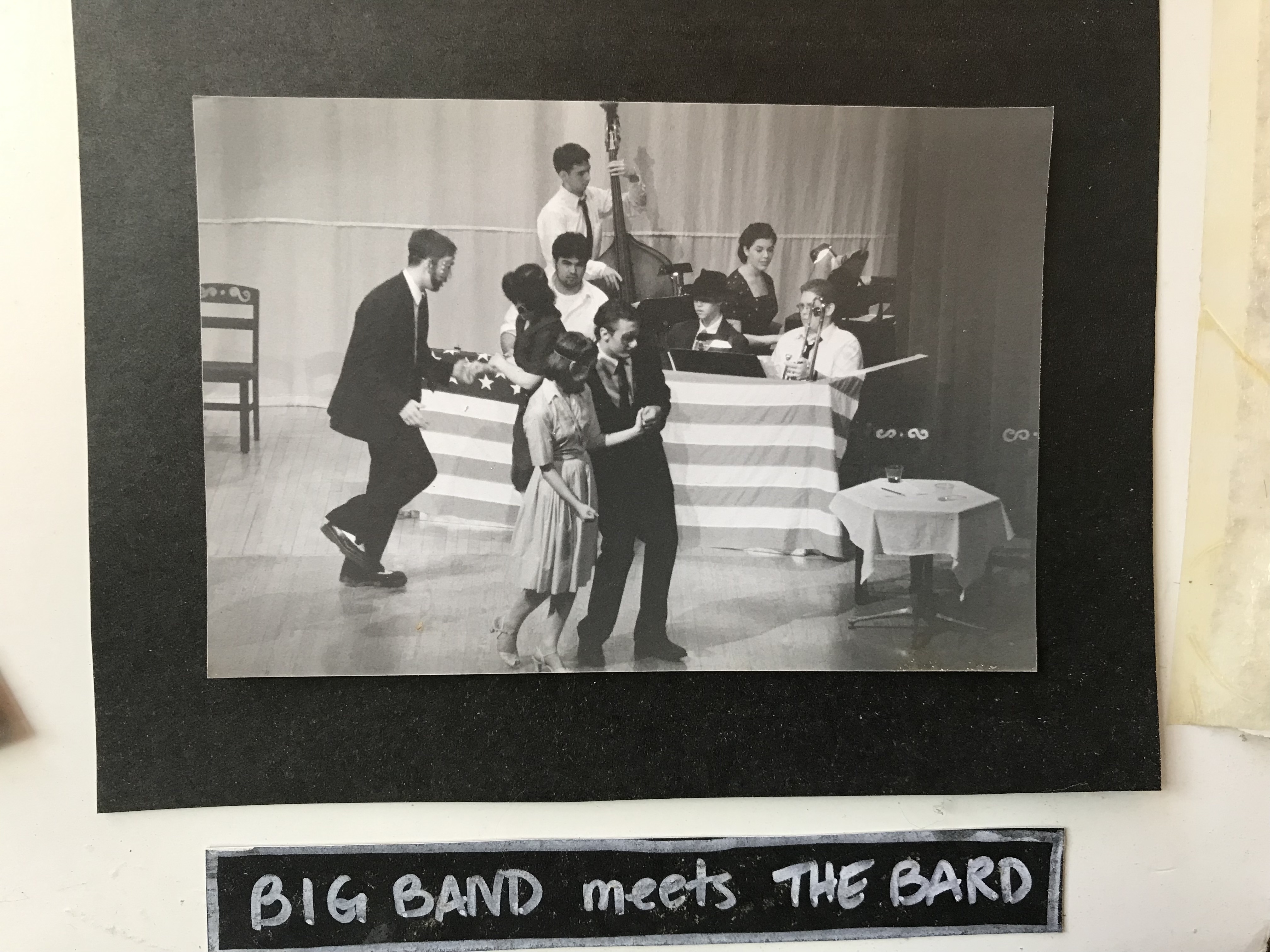
Much Ado Swing Style!

That year we produced Much Ado About Nothing.  It was the year Gap had been running the khakis swing dancing commercials, and since it was a post-war play we decided to set it in a post-WWII swing dancing era.  A local music teacher and composer set “Sigh No More” as a swing song (“Hey! Hey! Nonny Nonny, Hey! Hey! Nonny Nonny”) and “Goddess of the Night” as a slow blues tune. MaryAnn’s singing voice made her an excellent fit for Balthasar.  Her performances were beautiful but restrained. I could tell she still felt a bit hesitant.

Her junior year we did Merry Wives of Windsor.  She played Bardolph, still a small role, but one she took seriously.  Kids told me that she never broke character even backstage. It was also this year that I really began to understand how her brain worked.  She still struggled with reading text, but one day I discovered that she possessed outstanding verbal skills.

We were workshopping monologues in a variation of a “dropping in” exercise.  We’d asked her questions about the words in her text designed to provide her with emotional and visual context for her monologue.  Then, she stood up and performed it for us. When she finished, she just stood there. And I knew that she had gone somewhere…hypnotized almost.  We just sat there and waited. “The words….” she stammered and shook her head almost as if to clear the cobwebs. “The words….”

Then came her senior year.  We had decided to perform Henry IV Part 1.  Students had filled out audition sheets and when I got to hers I saw that she wanted to play Falstaff.  

Oh, boy.

So I called her into my office.

“I see that you want to play Falstaff.”

“Yeah, that would be great!”  

“There’s a lot of lines…a lot of memorization.”

“I know.  I know. But I can do it.  I promise.”

“There’s a lot of jokes about size, and..uh….”

“I know.  But I really want to do it.”

Thinking.  (Me). Waiting.  (Her).

“Alright, Let’s do it.” And so began one of the most powerful educational experiences of my life.

As a teacher or a student.

I liked to structure rehearsals like this:  On Monday we would rehearse a scene: work on the language, determine blocking and create characters.  (Only the actors involved in that scene needed to be there.) Then the next scene on Tuesday, maybe a couple of scenes on Wednesday, and so on.  On the last rehearsal of the week, usually Thursday or Friday, the entire cast would come. We would run the scenes we had already rehearsed word for word.  I expected actors to have memorized their lines for those scenes we had already rehearsed. Then, we would improvise the rest of the play. “Tell me the story,” I would shout from the audience.  I loved this part. A bit rocky at first, but week by week these run-throughs grew more and more comic.

MaryAnn came to her first rehearsals with her lines already memorized.  Not perfect, but pretty darn close. Although we never really talked about it, I’m pretty sure that she knew that it would be tough for her to read them and rehearse, so she prepared early.  And the results were astounding. Free from decoding text she found sight-gags and interpretations that went far beyond my creative abilities.

Indeed, she made good on her promise.  She learned all her lines; she created a strong character.  It turned out to be a highly engaging show with comedy, drama, music, and clanging and banging broadsword stage combat.  Word spread. By our last show, we had a packed house. And MaryAnn truly emerged as a star.

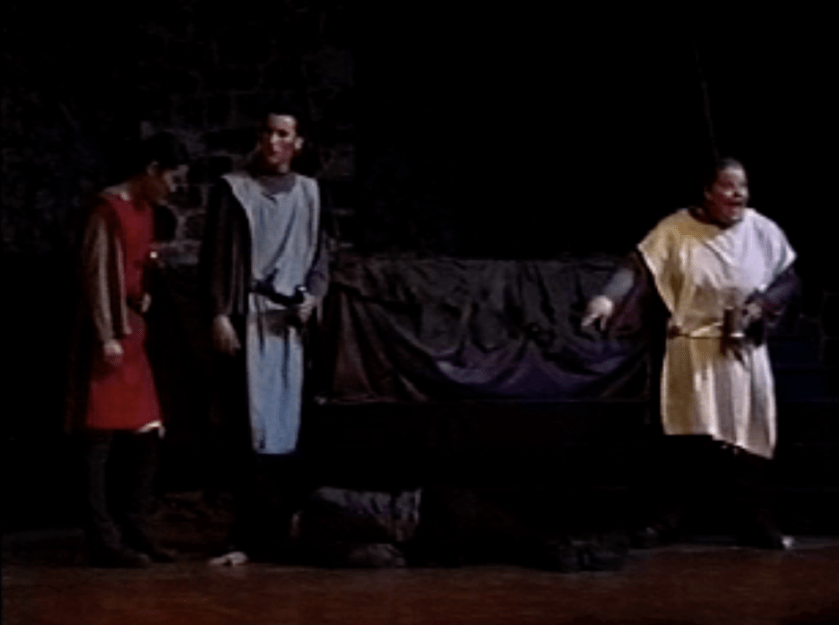
She had decided that Falstaff would ALWAYS have a pint of ale in his hand.  At the inn, on the road, and in battle. Late in the play, during a battle scene, Falstaff feigns death, (after carefully setting his ale down lest he spill a few drops) to avoid risking his life fighting Douglas the terrible Scot.  Meanwhile, on the other side of the stage, Hal, the protagonist succeeds in killing Hotspur the Antagonist. After Hal exits, Falstaff gets up and sees Hotspur lying there (after his “the better part of valor is discretion” speech.)  He decides that Hotspur looks scary even dead, and, lest he “counterfeit too and rise” Falstaff decides to stab him to be sure he IS dead. Moreover, even better, he can claim that Hotspur, merely wounded, rose again and that he, Falstaff, ultimately killed him. Again, MaryAnn made a hilarious interpretive choice here saying “Therefore, Sirrah, with a new wound in your…[closing her eyes and stabbing blindly, then looking]…thigh, come you along with me.”

The stage directions then state that Falstaff “Takes up Hotspur on his back.”  Fortunately for us (I’d love to claim that it was brilliant casting on my part but I don’t recall having the forethought for this), a 112-pound champion wrestler played Hotspur, so his athleticism and MaryAnn’s strength made this move possible.  Not only could she pick him up but she could also retrieve her pint of ale in the other hand. Of course….

Prince Hal and other members of the army of re-enter and question Falstaff about Hotspur’s death.  And then comes the stage direction, “Throwing the body down”, but how could Falstaff put him down without spilling the ale?  Once again, Hotspur’s athleticism came into play. Falstaff could heave him from his shoulder, and Hotspur could use stage combat falling technique to protect himself while making the fall look real.

“He’s dead.”


So, as I said, it’s a full house. Most of the audience hadn’t seen the show yet and have no idea this is coming.  MaryAnn heaves Hostpur from her shoulder who falls with a great clamor on the hardwood stage floor. There is a LOUD audible gasp from the audience. I’m pretty sure I heard multiple “Oh my God!”s. MaryAnn stops…looks at the audience, shrugs her shoulders, points to the body and whispers, “He’s dead.”

Uproarious laughter and a standing ovation on the spot!  And I’m choking because my body can’t decide to laugh or cry.  It’s HILARIOUS but I’m wiping away tears because I am so moved by the moment.  This shy, self-conscious, most likely dyslexic student has internalized Shakespeare and the language.  That’s exactly what Falstaff would have said! She has developed confidence. She’s, for the moment, the hero of the play. And I think, “This is why I teach Shakespeare.”

There is no Common Core standard for that. But it’s the most important. And yes, I fully agree that the rigor of Shakespeare’s texts develop literacy and cultural knowledge and…the list goes on.  But performing Shakespeare, even in low key settings of the classroom help build people, not just students.  Yes, there can be some anxiety.  (Anxiety is today what ADHD was in the 90s).   But our students need opportunities to work on overcoming this anxiety.  In a day where educational leaders and community members chant “Rigor!” studying and performing Shakespeare fits the playbill.

Performing Shakespeare builds community in the classroom.  Students learn to trust each other. They bond by overcoming shared challenges. They clap for each other; I clap for them.

Difficult moments will arise.  At the end of the unit, there’s usually at least one student who says, “I was terrified and never want to do it again.”  Others admit, “I was terrified, but I’m so proud of myself for doing it.” Believe it or not, though, a significant additional portion of students clamor, “That was fun, let’s we do it again!”

At that moment, I’m reminded of MaryAnn. I feel myself tearing up, and my students once again wonder what’s wrong with me.


Silly Sounds: Teaching Shakespeare Voice and Language

Many students initially object to Shakespeare because it sounds funny.  But funny in a bad way. Like, “hmmm, this milk smells funny.” This activity spins funny in a good way.  Like, “that scene from Comedy of Errors sure was funny!”  By using a non-traditional and non-serious approach to the text we can demystify Shakespeare, improve students’ diction, and increase their familiarity with the language.

A Brief Stint into Pedagogical Theory

Before we delve into the activity, we should discuss some pedagogical theory. ( Don’t worry, this won’t be as long and boring as a faculty meeting.)  Learning needs to happen through repetition. However, when repetition gets boring our brains check out so although we think we’re getting repetitions we’re really just wondering what we’ll do when Game of Thrones ends.  Thus, most efficient learning comes when we can engage in experiences similar enough to facilitate learning BUT varied enough to keep in fresh.  (Unlike the funny smelling milk.) That’s one of the reasons I love this activity.

Speak the Speech

All that you need for this activity is some text, a sense of adventure and trusting nature.  Essentially, students will read a text in a variety of ways. I usually place them in pairs and have them switch of reading when they come to a “major punctuation mark” like the end of a sentence, a colon or semi-colon.  That way they can get a bit of a break and, also, listen to someone else reading.

For all of these directions, I usually explain them briefly, then immediately say “Off you go,” then start modeling the directions myself.

First, I tell them to read while waving their hands in “dramatic flourishes.”  This does nothing to improve their reading but it increases the energy. I also have an unscientifically proven theory that this makes them feel more like real Shakespearean actors.  

Next, I tell them to pronounce ONLY the consonant sounds.  After I remind them what a consonant is, I model a line. For example, the line “This thing of darkness I acknowledge mine” would sound like “Thsthngfdrknsscknldgmn.”  It’s like Pig Latin but more chaotic.

Then, you guessed it…vowels.  This gets even sillier. “I have of late but wherefore I know not” sounds like,” I-a-o-a-u-e-o-io-o.”  

After vowels I usually have students vacillate through their vocal range.  The begin a line talking really low like Darth Vader and gradually, over the course of the line talk in a high voice like Michael Jackson, then back down again.

Then I get really crazy.  Sometimes I have them sing…opera, rap, country twang.  Then in an “outrageous accent. Really OUTRAGEOUS.” Some students become a bit hesitant here, but others leap right into it.  There’s usually quite a bit of giggling going on at this point. From the students, too. If so, I know the activity has been a success.

I always end with a whisper.  But I tell them “not to lose a single sound.”  This variation fosters precision in their articulation.  It also helps to restore a bit of order and focus. Chaos can be great but needs to be reigned in before we can shift our focus to scene work.

At the beginning of a Shakespeare unit, I do this activity as a warm up about twice a week.  I see a dramatic improvement in the fluidity of their reading and the clarity of their diction.  Give it a try and be sure to send me a recording of the outrageous accents!

https://youtu.be/5gmXKl4FwCk

Check out some student examples!