Teaching the Power of Connotation in Shakespeare

When I was a kid, I loved Wonderbread.  Seems odd now…I think it tastes like paste.  Then again, I liked paste when I was a kid, too.  

Paste and Wonderbread…not really much flavor there.  White, bland, lacking in nuance.

Unlike Shakespeare.  The complexities of language stimulate the eyes, the ears, and the heart.  Like Tim O’Brien says in The Things They Carried, you can feel a true war story with the stomach.

However, without sophisticated language skills, it is impossible to truly experience the full effect of Shakespeare.  It takes a developed palate to appreciate artisan whole grain bread, so we must help students develop an appetite for dense language.

I begin teaching the concept of connotation by drawing a line on the board.  I explain that the line represents a continuum of negative feelings, or connotation, on the left and positive feelings on the right.  Then, right in the middle, I write the word “economical.” Then pick a random student and make up a story.

“We all know that Chad has been working a lot lately.  He’s been saving up for a new truck. Been doing pretty well, too, banked a couple hundred dollars last week.  But, he just started dating this girl, and it’s her birthday, so he has to choose: money for his truck or for a birthday present?  He needs a truck to get to work, but he really likes this girl.

Let’s say we like Chad, and respect his choice to spend $8 on some flowers from the grocery store.  What word would best describe his financial choice? Frugal? Yes, that means responsible with money.  Now let’s pretend that we’re jealous. We like the girl and would spend more money to really demonstrate our affections.  How would we describe Chad then? Cheap? A Tightwad? Absolutely.

See how the three words mean essentially the same: conservative with money.  However, they carry different emotional meanings, or connotations, which reveal tone…how the writer or speaker feels.  ‘Frugal’ shows that we respect Chad. ‘Cheap’ reveals that we despise him. ”

That’s my introduction. I will then reinforce the concept with another triad of similar words, skinny, thin, and slender, perhaps, or sluggish, slow, and leisurely.  

…a ray of sunshine

Many times I will transition this lesson directly into one about similes and metaphors.  I make the point to students that when invoking a comparison, a writer invokes the emotional value of that object.  For example, the metaphor “Catherine is a ray of sunshine in her father’s life” conjures the positive aspects of sunshine: warmth and brightness.  Or, on the other hand, the indirect metaphor, “Catherine slithered into the room” invokes the negative connotations of a snake: deceitful, venomous, and evil.  

Once students understand how specific word choices reveal tone, we can begin exploring how Shakespeare employs this concept.  I find that, at first, when many students read Shakespeare I feel like I’m eating Wonderbread again. There’s hardly any inflection, little emotion, and, even in a performance setting, no facial expression or body language.  In these situations, students have not had an opportunity to connect with the text.
Dropping in…

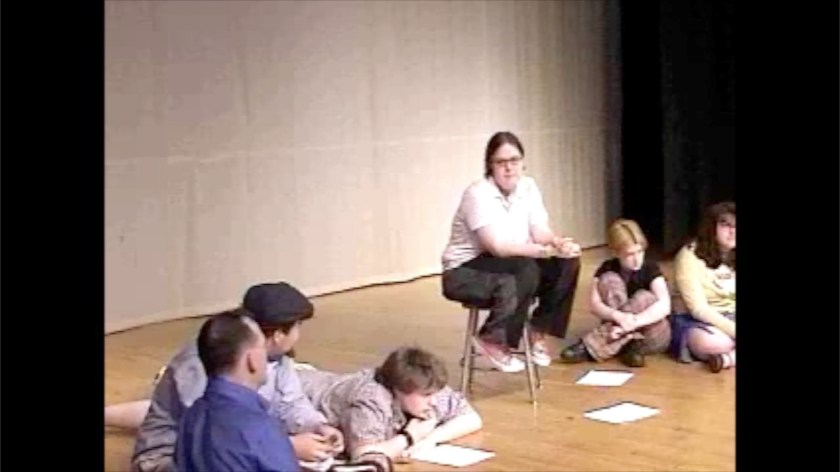
This process, however, provides a chance to relate the language to their memories and prior knowledge.  It’s based on this activity from Shakespeare and Company called “Dropping In.”  However, I use a variation that, quite frankly, I can’t remember how much came from the workshop that I attended, additional reading, or adaptation over time.  But anyway, it goes like this:

I put students in groups of four and give them a section of text that contains connotation laden language.  I ask them to read through the passage and make a list of the powerful words. After each group has selected their words, I model the following process then ask each group to continue on their own.

Each student takes a turn in the “hot-seat.”   They don’t have to do anything but think and point.  The group chooses a word from the list on which to focus.  Then they take turns asking the hot-seat student a question about that word.  When they formulate a question, they raise their hand. When the hot-seat student points at them, they may ask the question.  The hot-seat students don’t answer, they simply think about their response. During that time, the other group members think of other questions and raise their hands.  It is important that group members raise their hands. If they blurt out questions before the hot-seat student has had an opportunity to process the previous question, then the opportunity to “form bonds” with that word has been lost.

Let’s consider, for example, the word “rage.”  I might ask:

When’s the last time you felt rage?
Have you ever caused someone else to feel rage?
Does rage build slowly or come in a flash?
Where in the body does rage live?
If one particular animal symbolized rage, what would it be?
If you wanted to communicate rage with a musical instrument, which one would
you use?

I tell students to ask as many questions as they can.  When they begin running out of questions, move on to the next word.  If I have an actor working on a particular speech, I leave that person in the hot-seat.  If we are doing classwork, I rotate each group member through the hot-seat with each new word.  I find that although being in the hot-seat intensifies the experience, all group members receive the benefit of internalizing the questions.

After the groups have covered their list of words, or after a set amount of time, whichever best meets the needs of the lesson or class, I have each student stand with a copy of the text, and recite the passage, out loud, to the wall.  (Or, if I’m in the theater I have them perform it out to “the space.” If I have them face the middle of the room they become distracted looking at each other and do not fully engage with the text.) Then we discuss as a class, “how did you find reading the passage at the end as opposed to the beginning?”  Inevitably, students say that not only did the passage make more sense but it also seemed to resonate much more…they were better able to see and feel the images.
MaryAnn as Falstaff

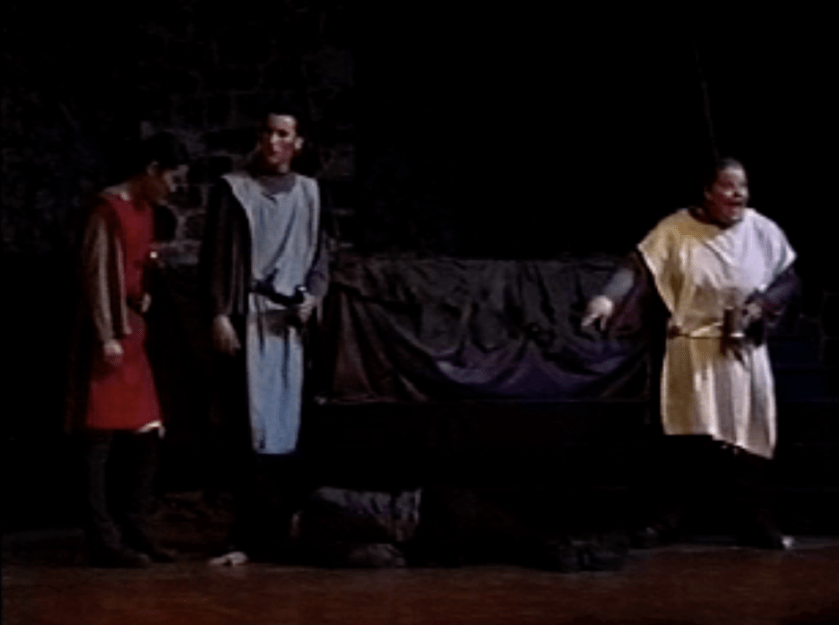
One of my most powerful experiences with this activity came from working with MaryAnne.  As a student, she struggled with the decoding of text but performed well once she embedded the language into her head.  She was working on a monologue from Comedy of Errors.  She had picked out her list of words and several of her cast mates and I sat on the stage asking her questions.  

After we had finished, she stood up and performed the monologue for us.  The words seemed to resonate from somewhere deep. They carried tone, color, and nuance.  We could hear and see the connotation of all the power words. And she, too, seemed to be carried off somewhere.  When she finished, she just stood there. We just sat there, not just rapt in the performance but aware that we were witnessing someone fully experiencing Shakespeare.  I remember her shaking her head, blinking her eyes several times and saying, “the words…the words.” I truly believe that she had, in some manner, hypnotized herself with the language.

On the other end of the spectrum, I find that some classes need me to help them maintain an academic environment.  There’s a fine line between having fun with some silly questions and not taking the activity seriously Other students may need help them come up with questions. , so be prepared to help focus some groups and help create questions.  Perhaps even a reference sheet with questions like “When was the last time you felt______?” “What’s your strongest memory of__________?” would be useful for struggling students.

So much of the artistry in Shakespeare comes from his word choices.  His working vocabulary of 50,000 words, however, often overwhelms students with developing verbal palates. Teach them to chew, however, and really savor the subtle flavors of each morsel, and they will never go back to Wonderbread.
How to Increase Student Energy Level in Shakespeare Performances

Hesitant, inexperienced, and nervous student actors often rehearse and perform with all the urgency of a snail creeping unwillingly to school. They find it difficult to understand the importance of energy without concrete instruction. Thus, giving them an anchor of various energy levels often help elucidate the subject for them.

Here is the script I use for this activity. I model each level by doing the activity with the students.

Okay, this activity is called the Seven Levels of Energy.

No Energy!

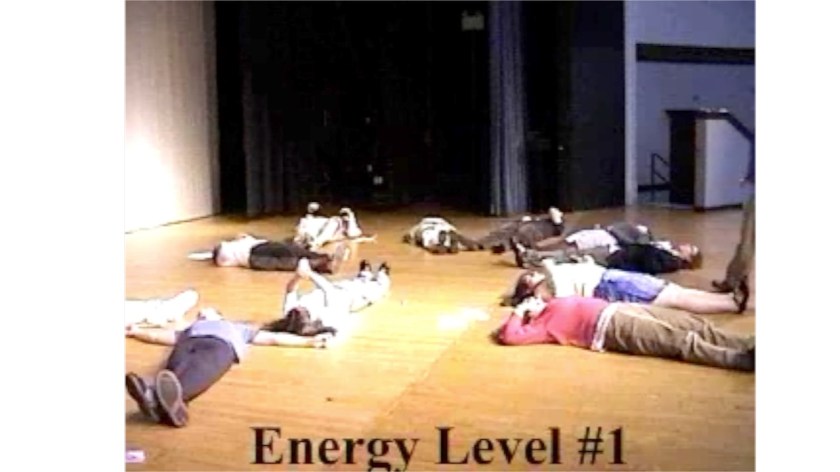
Energy Level #1

So, everyone lie down on the floor. Yes…on the floor. On your backs. Eyes closed. This is energy level number one. Imagine that gravity, an overwhelming force, pushes you into the floor. You are like a pool of liquid. You are so tired that you can barely lift your fingers. Go ahead, struggle to lift a finger. It’s Monday morning and you struggle to get out of bed at energy level number one.

Energy Level #2

Fortunately, or unfortunately, depending on how you look at it, we can’t stay at energy level number one. We have things to do. So, at energy level number two, which takes all of your effort and concentration, struggle to your feet. That’s right, do that now…struggle to your feet where you can barely stand because it feels like you have a thousand pounds on your back. You even stagger a bit trying to maintain your balance. Nope, you can’t talk at energy level number two, you can barely stand. Feel that weight on your back. Okay, good.

Energy Level #3

Well, we can’t stay at energy level number two, either, so let’s go find the coffee machine. At energy level number three, if we concentrate really hard, we can move from point A to point B. We may sway a bit, side to side because we’ve still got that heavy weight on our back. Nope, still can’t talk at energy level number 3, it takes all our concentration to get to one spot. Then we have to pause, rest then get to the next spot.

Energy Level #4

Now that we’ve had our coffee, we can move onto energy level number four. This is normal everyday walking around with no particular purpose. Oh, there’s people in this world. Yes, now we can talk to them. “Hey, how’s it going? Good. You?” Yup, just walking around with no particular purpose, no urgency. Not like you guys, of course, but perhaps some of my less motivated students…. Just walking around normally. Ho-hum. The thing is, with energy level number four, nothing gets done. There are no stakes, nothing matter, no one cares. Until we get to energy level number five.

Energy Level #5

Okay, now we’ve got purpose! We have goals to accomplish! I need to move this chair over here. I need to carry this backpack over there. Very Important! This needs to be done and done correctly or there will be consequences…significant consequences. I need to come over here and tell Jack that our performance today is essential to our success! Very important! Move with purpose. Move with urgency. Pick up the pace. I have clear objectives, clear goals. I’m motivated.

Energy Level #6

When we get to energy level six, we’re late! We’ve got to run! It’s critical! Lives are at stake! Our future! Run, run, run! This has to be done NOW!! The essay is due in 15 minutes! I need to score the winning touchdown! Go, go, go! Something really bad is going to happen if we don’t get this done! High stakes! We must not fail!

Energy!!!

Energy Level #7

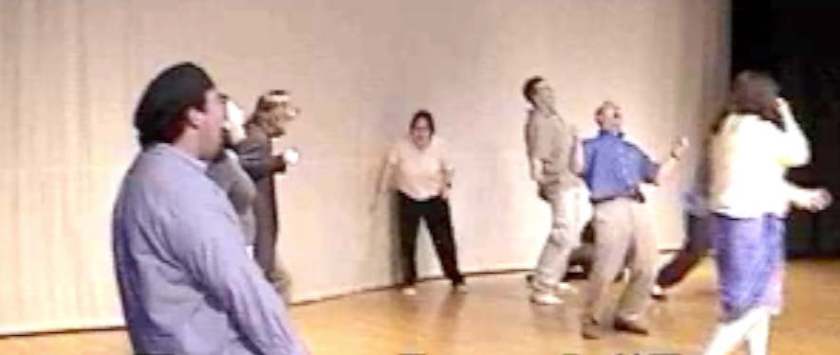
When we get all worked up, we sometimes move to energy level number seven where all we can do is scream: “AHHHHHHHHRGGGGHHHHHH!” and collapse to the floor. Back to energy level number one. We’re exhausted again and feel heavy. Kind of feels like most days of my life…

Debriefing

After completing the activity, I gather students in a circle to talk about it. I always ask, in theater, which energy level should we avoid like the plague? Inevitably they say, “Number one!” to which I reply, “My friend, Mark, once played Julius Ceasar. After they stabbed him he had to lie on stage for 15 minutes of Mark Antony’s speech. He was in three shows and was tired. I often had to kick him so he would stop snoring. That’s pretty much energy level number one”

“Okay, energy level number two.”

“Imagine you are wounded, or really old. I’ll bet you would walk like that…hunched over, feeling like you had a heavy weight on your back.”

“Okay, four! Yeah, energy level number four, avoid that.”

Exactly. Energy level number four doesn’t “read.” It communicates nothing. It’s emotionless. One, two and three can show several different emotional states. Six and seven, definitely. But four? Boring. Uninvolved. Purposeless.

I suggest focusing on energy level number five. Make sure your character work to accomplish something. Know what they want and that getting it is important to them. If your characters don’t care, the audience won’t care and they’ll be bored with your scene.

Think of theater like the Arnold Schwarzenegger movie Kindergarten Cop. Has anyone seen it? No? I know, I’m getting too old. Anyway, in this movie, Arnold plays a police officer. He’s used to getting what he wants, justice, by beating up bad guys. However, when he takes an undercover job as a kindergarten teacher, he can’t beat up little kids, so has to learn to use LANGUAGE to achieve his goals. That’s what theater is all about. Think about how your character uses words to accomplish goals.

Bonus Strategies

Although the Seven Levels of Energy activity works well to communicate the theory, sometimes students need some additional practice to put the concept into practice. If I see a group hovering around energy level number four, I usually give them two additional challenges.

Four Corners

I place each of the scene members in the four corners of the performing space…the farther apart, the better. If we rehearse in the auditorium, I tell them to stand way out in the corners of the seats. “Okay,” I say. “Stay in character and project your lines across the space to your scene partners.” While this challenge works well for “soft talkers” as well, it helps to increase the energy with which they speak.

Speed-through

Another strategy I use to increase energy levels is the speed-through. I tell students to literally RUN through the scene, speaking as quickly as possible without losing any of the sounds of their words. Imagine that you are racing another group performing the same scene. If you drop any words, you’d have to restart, so maintain line integrity, but GO FAST! This often creates the urgency necessary to transform a lackluster energy level to a more dynamic one.

Fun Fact

I was presenting this activity at a conference in Denver one year and during energy level number six someone moved my presentation notes. I never found them. Luckily I had my presentation pretty well anchored in my head so we were able to press on without any problems. It was a fun group and well worth losing notes!

Acting Shakespeare can understandably intimidate students and inexperienced actors. This reluctance often translates into dull scenes that do little to combat the notion that Shakespeare plays are lively and dynamic. However, these teaching strategies will help reticent students understand the appropriate energy level necessary for entertaining scenes!

3 Dynamic Strategies for Teaching Shakespeare’s Language

If you’ve never seen comedian John Branyan’s “Three Little Pigs” Shakespeare style, go watch it now.  It’s hilarious. I’ll wait.

Still laughing?  (I loved it so much I memorized it as a monologue.)  But he’s right: Shakespeare used over 30,000 words in his writing.  While researchers suggest that modern audiences use more than the 3000 words suggested by Branyan, many teachers can identify with his line “‘What light through yonder window…’ What?  Does this come on a DVD?”

In order to convince students that Shakespeare can be fun, we must first show them that the language can be accessible.  (Hey, a significant portion of Shakespeare’s original audience couldn’t even read!)

I use variations of the following activities to accomplish simple goals.  First, I want to foster familiarity. In other words, provide enough repetitions in speaking and listening so that the language starts to hear and feel “normal.”  Second, I want to build voice skills of accurately reproducing the phonetic sounds as well as the proper phrasing. And I want to do this in ways that engage all students.

The structure of the Language

Students are not used to reading text in verse format.  Thus, the inevitable pauses they place at the end of every line, needed or not, distort the rhythm and parsing of meaning.  To help them, I use an activity called “Text Surfing.”

I say a sentence containing a list separated by commas.  Something like, “This weekend I’m going on a canoe trip so I need to remember my paddle, my PFD, my canoe, and my splash gear.”  Then I ask the students: when I finished saying “paddle,” how did you know that I wasn’t done my list? After several smart-alecky answers, we get to the truth of that matter that my voice inflection stays high, whereas, after “splash gear,” my voice inflection goes down.  

Then I write the sentence on the board and illustrate my rising inflection by making a swooping motion up with my hand at each comma.  I direct the students to follow along with me.

After introducing the concept I break out the Shakespeare text.  I tell students to read it while paying attention to the punctuation.  At everything except a period or exclamation point, they should raise the inflection of their voice and, for emphasis, make the swooping motion with their hand.  I will sometimes pair them up and have them switch at every complete sentence if I feel they need some social interaction. I have them read for five minutes or so, circulating around the room and reminding them to “keep swooping!”

I tell them not to worry about meaning at all.  In fact, I don’t care if they “understand a single word!”  I simply want them to pay attention to the phrasing.

I like this activity for its simplicity.  Rather than overwhelming students with complex meanings early in the unit, I focus on building success and familiarity one phrase at a time.

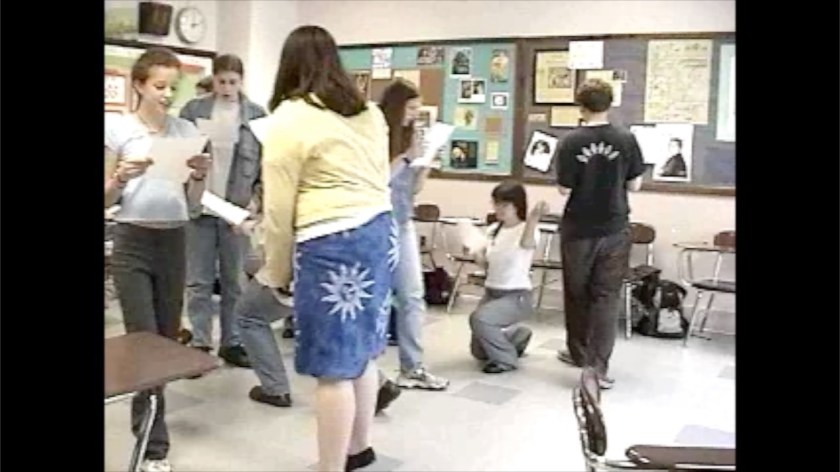
I call the second activity “Traveling Passage.”  Similar to “Text Surfing” this activity focuses on the phrasing of the language.  It adds, however, another layer of complexity. In addition, I like it because I can add movement.  In this activity, I ask students to walk around the room while reading a selection of text. (Verse works better than prose.)  When they come to a comma, change direction. When they come to a period, stop. When they come to an exclamation point, jump. When they come to a question mark, kneel.  When they come to a semicolon or colon, shuffle their feet.

This can become a bit chaotic especially with a larger class in a small space.  Embrace the chaos! The point is not to think about the theological ramifications of killing Claudius while he prays but rather to increase familiarity with the language and, hopefully, teach neophyte Shakespeareans not to stop at the end of every line.  Understanding the nuances of meaning will come later!

Sometimes I find reducing Shakespeare to the ridiculous provides a wonderful catalyst for shattering student illusions that studying Shakespeare should be reverential and plodding.  The language concept of inversion often contributes to this notion. Placing the subject and verb at the end of the sentence just sounds weird. Until you justify it by saying that Yoda does it all the time.  For example, “When nine hundred years old you reach, look as good you will not.”  If I have several Star Wars fans in class, I ask them to quote their favorite Yoda lines with inversion.  

Then comes “Inversion Improv!” I ask for three students volunteers.  I give them a situation like, “You’re on your way to a concert but got a flat tire,” and two minutes to improvise a scene where they introduce and solve the problem…while speaking in inversion the entire time.  While it can be a challenge for some students, this activity has a huge upside: it’s funny, it’s dynamic and interactive, and it provides an opportunity to illustrate a component fo Shakespeare’s language and make it more understandable.

Language study does not have to be boring.  In fact, it definitely shouldn’t be early in the unit.  We can get more in-depth as we progress through the play.  However, by using these hands-on, kinesthetic, and auditory activities, teachers can provide the scaffolding for more complex learning.

How I Evolved to Teaching Shakespeare through Performance

-Ted Tibbetts

We spend way too much time unpacking the language of rubrics.  And, yes, I know, we want to make learning objectives clear for our students.  And, yes, we want instruction, in some degree, to be data-driven. But when I think of the amount to time we spend sitting around in meetings trying to cram content into a digital receptacle and trying to pinpoint what we really mean by “sophisticated topic development,”  I feel like a fly to the wanton gods. The most important learning can’t be measured in rubrics.

I was never an actor.  In high school musicals, I played trombone in the pit band.  In college, I played guitar and sang the songs with a lot of lyrics.  (I was the only one who could remember all the words.) Throughout that time, however, I became more and more interested in Shakespeare.  In graduate school, I TA’d for a Shakespeare class. Then I saw audition signs for Much Ado About Nothing.  I figured if I truly was going to do this “Shakespeare Thing,” (whatever that was) I should experience it from the stage as well as the library.  Besides, I was a musician and vocalist, how hard could a theater audition be?

I memorized, I practiced, I showed up…I forgot most of my lines.  I fled to the comfort of the library (or was it the pub?) thinking my Shakespearean acting career was a tale told by an idiot. A week later I received a call from a grumpy and terse stage manager:  “Do you want this part or not?”

“Part? What part?”

“You didn’t check the door?”

“What door?”

Various mumblings and expletives.  

Anyway, I had garnered the part of George Seacoal.  A brilliant casting, actually. The director awarded the educated but hopelessly inexperienced actor with a three-line part, who could actually be considered the hero of the play:  he captures the villain. (Fun fact, by the way, the kid playing Claudio had been on the TV show Who’s the Boss with Tony Danza).  

So, I thought, “This is good.  I can learn Shakespeare theater with a small part and finish my homework during rehearsal.

I didn’t do ANY homework during rehearsal. But what I learned about Shakespearean theater affected teaching for the rest of my career.  For years I had learned Shakespeare from an intellectual perspective, and, on occasion, from an audience’s perspective. However, the director facilitated activities in which students experienced the text with their hearts and bodies as well.  And the rhythms, lines, language, and images continued to resonate in my head for hours after rehearsal.

When I began teaching Shakespeare in the classroom, I used similar strategies.  While I didn’t have that director’s experience or theater knowledge, I did the best I could…and I attended workshops and conferences and researched theater techniques.  

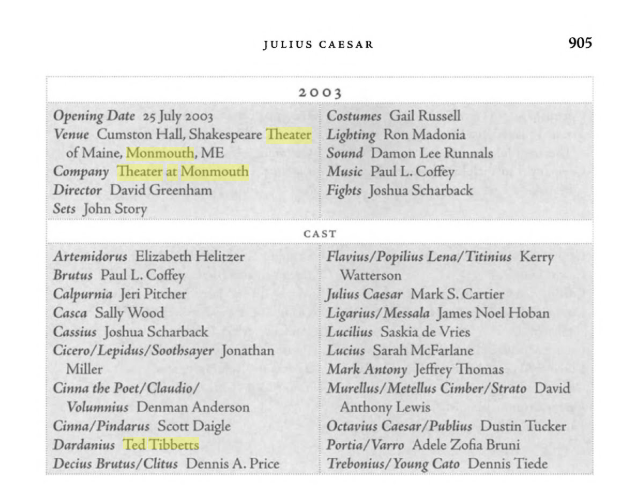
Woohoo! There I am as Dardanius! (Who the heck is Dardanius?!)

I also met the managing director of a local Shakespeare theater who visited my class once.  I asked him if I could audition for a play. (I decided to leave out the details of my last audition.)  He said, “no need, I’ve got a part all picked out for you.” So, I went on to add “Professional Shakespeare Actor” to my resume.  Which really means they paid me $75 for the summer, that didn’t even cover gasoline expenses, to play various tiny roles…that I loved!  I wasn’t in it for just the acting; I wanted to watch professionals prepare. I carried around a notebook, not for my own parts, but to ask the pros how they approached the text.  I added these strategies to my teaching arsenal.

This approach made all the difference.  Students showed up to school 15 minutes early to ask if they could work on their scenes.  I started teaching a Shakespeare through Performance elective. Several students went off to a summer Shakespeare program.  They went to the drama club, then came to me and said, “It was pretty cool, but it wasn’t Shakespeare. What if we had a separate club just dedicated to Shakespeare?”  I thought, “Well, we’d probably have a dozen or so kids, why not?”

We ended up with around 25 students in the club, which turned out to be one of the most powerful student groups with which I’ve worked.  In the fall we worked on skill development, ensemble building, and everyone learned a monologue (including me). In the winter, we cut a play to a 15-minute farce.  In the spring we produced a full-length Shakespeare play and the first week of summer vacation we spend at the Royal Shakespeare Company workshopping with RSC actors during the day and attending the theater at night.  It was truly an incredible experience. We completely took over a Bed and Breakfast in Stratford. One year I had the forethought to buy an extra ticket to the evening shows “just in case,” so I invited Bridget, the B&B owner to join us for the evening.  “That would be lovely,” she said in her proper English accent. “I haven’t had a chance to get out to the theater all season. And” she added with a bit of a twinkle in her eye,” I know where the actors go after the show.”

So off to Comedy of Errors that night.  Then to the Dirty Duck after the show to, hopefully, catch up with some of the actors.  They came in alright, with their friends, and were immediately accosted by my students asking them to sign programs.  Seeming a bit taken aback they politely acquiesced, then returned their attention to their peers.

For better or worse, American high school students are louder than British actors. Loud as they might have been, however, ignorant they were not.  All had covered a Shakespeare play each year in English class. Most had taken the Shakespeare elective which covered four or five plays a semester, and in the club, we had referenced, workshopped or performed several more.  So, forsooth, many of these students could speak knowledgeably about 15 or more plays. Enthusiastically they were connecting the Comedy of Errors to other plays, quoting various lines, talking about their favorite parts of the play and I could see the actors looking over with quizzical glances seeming to say: “Who the hell are these kids?”  Within an hour the actors had ditched their friends and were hanging out with the students talking “shop.” (By the way, this can’t be assessed with a rubric. Can you imagine, though? “Can converse knowledgeably in a pub with an RSC actor about a line from Titus Andronicus…Exceeds the Standard!”)

I have continued to teach Shakespeare this way ever since.  While I have changed schools and no longer direct a Shakespearean acting troupe, I still look forward to…okay, long for, those Shakespeare units.  Admittedly, some of my more introverted students don’t look forward to it as much as me, but many do. And the growth that results from performing Shakespeare rivals any learning experience I witness in school.  (To read my story about MaryAnn, click here!)

If someone like me, who forgot most of their lines in an audition, can use theater strategies to teach Shakespeare, anyone can!  Give it a try, share the experience with your students, rethink the “Complete Works” and put the play back in Shakespeare!

.

7 Tips for Memorization

-Ted Tibbetts

Memorization has become a lost art.  Proof? Recite four phone numbers from memory.  If you can do it, you’re better than me! With immediate hand-held access to information, we seldom need to learn anything by heart.  However, situations occasionally arrive when we wish we had the brain power to commit things to memory. These seven strategies will help!

1. Read and Repeat

In this method, you read the words, then repeat them to yourself over and over.  This traditional method has stood the test of time for a reason: it works. Kind of.  The big challenge comes with maintaining engagement. Often we think we are repeating the words in our head but, rather, we think about what’s for dinner thereby negating the process of lodging these words into long-term memory.  Instead, we’ve just wasted 20 minutes. This approach can be effective, however.

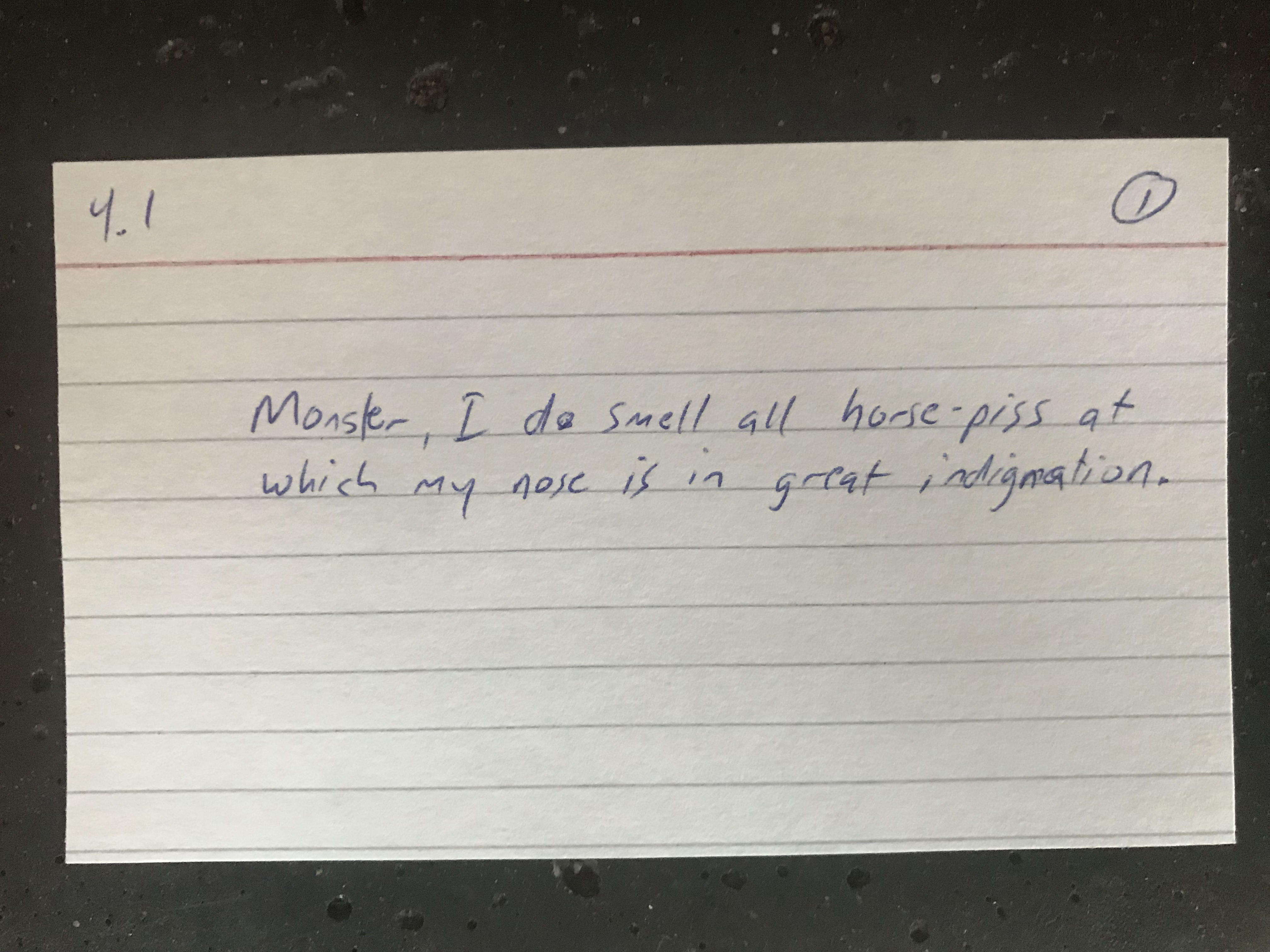
Consider adding the following steps.  Write cue lines on one side of an index card, then write your lines that come after on the other side.  Maintain line integrity: in other words, begin a new line on the card as it shows on the script. This will help to parse the text appropriately.  In addition, write the act and scene in the top left of the card, and number the lines in order in the top right. This will help reorganize them when you inevitably drop them on the floor.  

Lines with Act / Scene and card number

Carry a few cards around with you over the course of the day.  Set goals for yourself like, “I’m going to learn these two cards by the end of the day.”  Then, whenever you have a quick moment, pull them out and rehearse the lines. Spending 30 seconds ten times a day will be far more effective than spending five minutes all at once.  Moreover, you can capitalize on those “dead” times like when you are waiting in line or walking from one place to another.

2.  Record and Listen

With the ubiquity of earbuds these days and the proliferation of podcasts, auditory channels can be a highly effective way to transfer information. Record your lines with a voice recorder app, then play them back on your phone.  You’ve just created your own line podcast!

3.  One Word at a Time

This approach can be tedious but highly effective for those slippery lines that just don’t seem to stick.  Part of its effectiveness comes from the repetitions you get from the recall. It’s like those times where you say, “I know it, it’s on the tip of my tongue” but you have to mentally grope for the thought.  It’s lodged in your brain somewhere, but you’ve only created one neural pathway to retrieve that bit of information and your brain says, “Now where did I put that file?” In this technique, you exponentially increase the number of recall repetitions.  For example, say you want to memorize Hamlet’s line “I have of late, but wherefore I know not, lost all my mirth.” You would say, “I…I have…I have of…I have of late…I have of late but” and so on, until you have committed that line to memory. Be sure to deliberately look away from the page so you know you aren’t merely reading the line.  As I said, it takes time and is tedious. Thus, I save its use for those awkward lines with which I struggle.

4.  Backward Line Recall

Like the One Word at a Time technique, this strategy can also be tedious and also incredibly challenging.  But, it is an outstanding way to firmly anchor text in memory and smooth out lines plagued by a slow recall.  Review the line on which you want to focus, then try to say it backward. For example, Macbeth’s line would be, “nothing signifying fury and sound of full idiot an by told tale a is it.”  Forcing the brain to grasp the relationships between the words strengthen and deepen the neural connections and make recall much smoother and faster.

5.  Pictographs

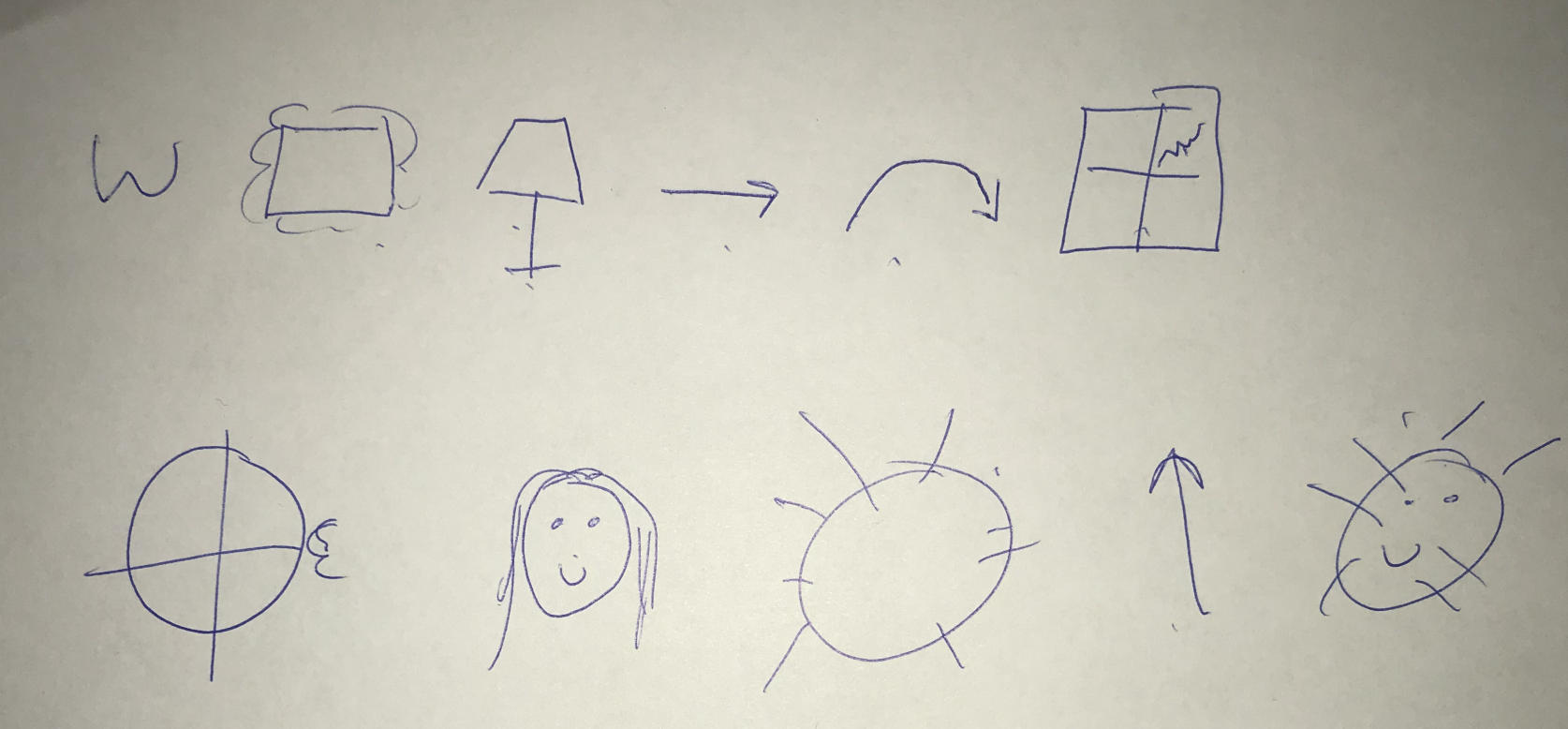
Pictographs

This method may be the most powerful because it works on several levels.  Draw a quick picture or symbol that represents most of the words of the line.  (I usually skip articles and prepositions) This is not fine art and does not have to be a direct representation of the word, just something that you associate with the word.  For example, for Romeo’s line, “But soft, what light through yonder window breaks, it is the East and Juliet is the sun,” I would draw, well, a butt, then a pillow, (because it’s soft), then a lamp, then a straight arrow to represent “through” then an arc arrow to represent “yonder,” then a window, then a crack in the window for “breaks.” A compass for “East,”  a face with long hair for “Juliet,” and then a sun. You should do this quickly for time’s sake and not agonize over getting the perfect image. You just want to connect an image with a word. By doing so, you are creating additional neural connections since the brain processes images differently than words. In addition, unlike the Read and Repeat, there is no way to mentally check out of this exercise…you have to stay engaged.

6.  Objects

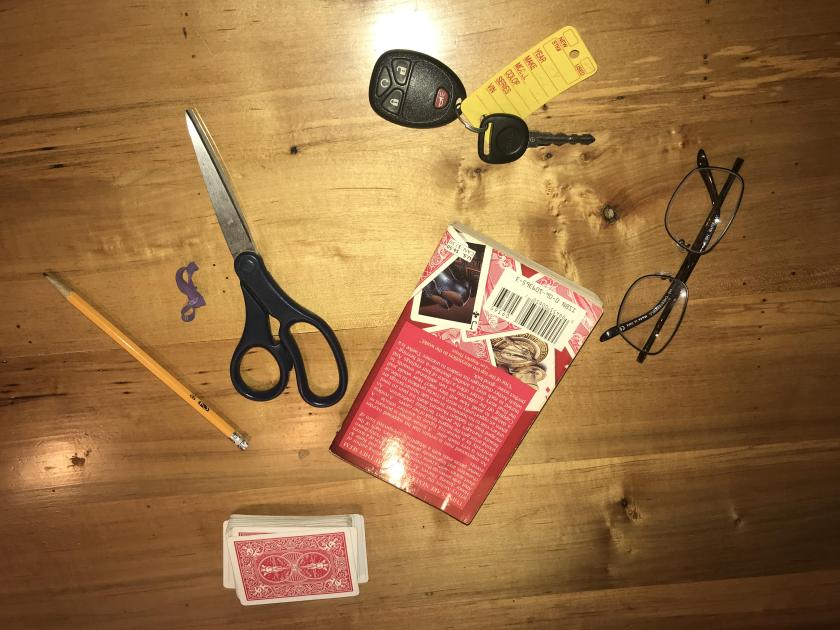
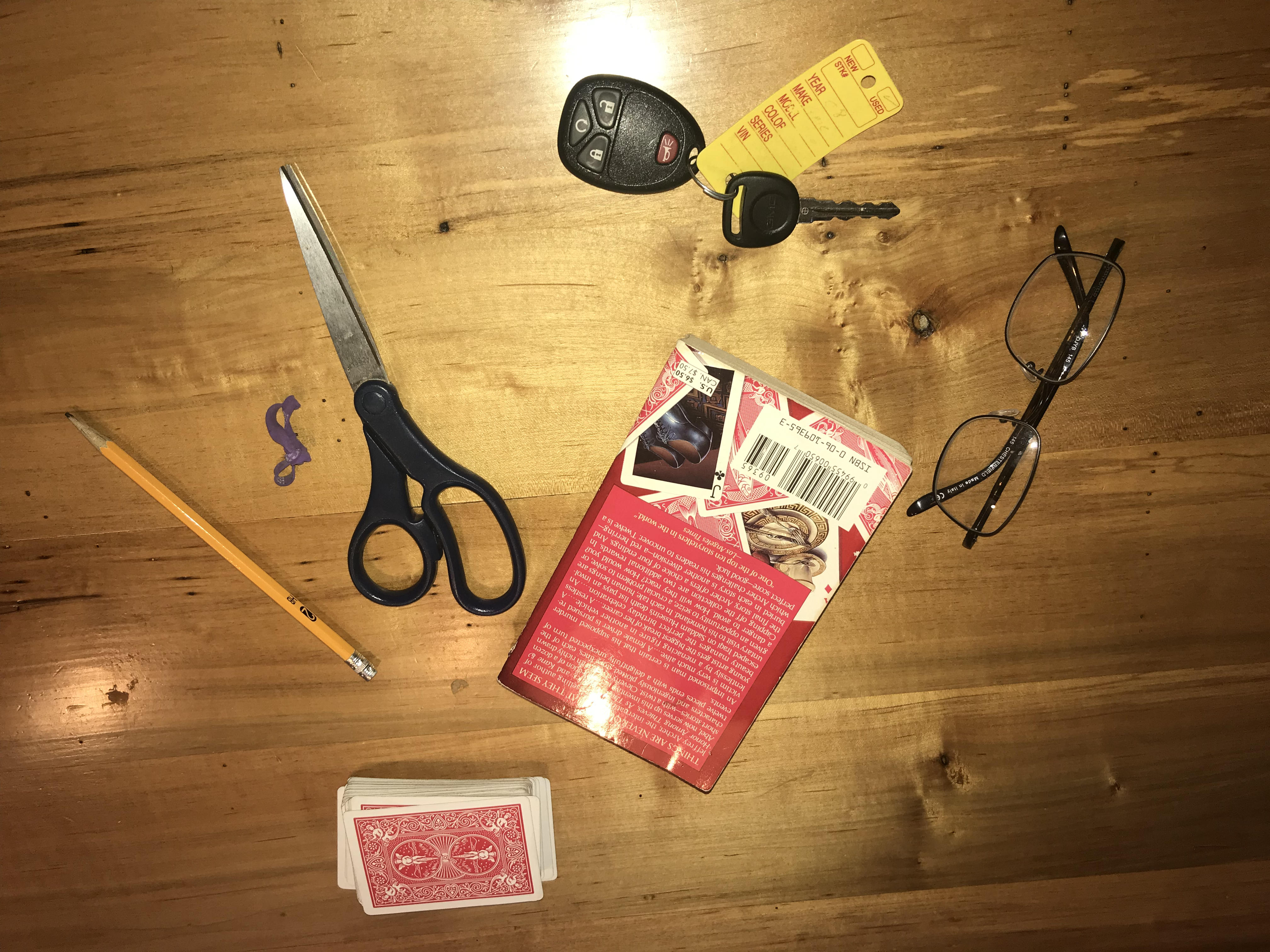
Like pictograms, using objects highly engages different parts of the brain and also the body for those kinesthetic learners.  Assemble a pile of about a dozen different random objects: keys, a cell phone, a pencil, chapstick, a coin, some scissors, a roll of tape, a hat, a shoe, some glasses, a tack, and a book for example.  Then assign the object to a word in the line that you want to memorize and “animate” it as you say the word. Say, for example, you want to learn Marc Antony’s line: “I come to bury Caesar not to praise him.”  I would say something like, “Okay, ‘I’…well, glasses go over the eyes, so the glasses are “I.” And, “come”…well, I need keys to drive to come home. Then “‘to bury.’ Well, I’ve been buried with reading lately so the book will be that.  Then ‘Caesar.’ He was stabbed…so scissors will be Caesar. And so on, until each significant word has an object attached to it. Then, say the line while picking up the associated object. Once you have the line down, begin picking up the objects in random order and saying the word until the line becomes smooth.

7.   Weird Places

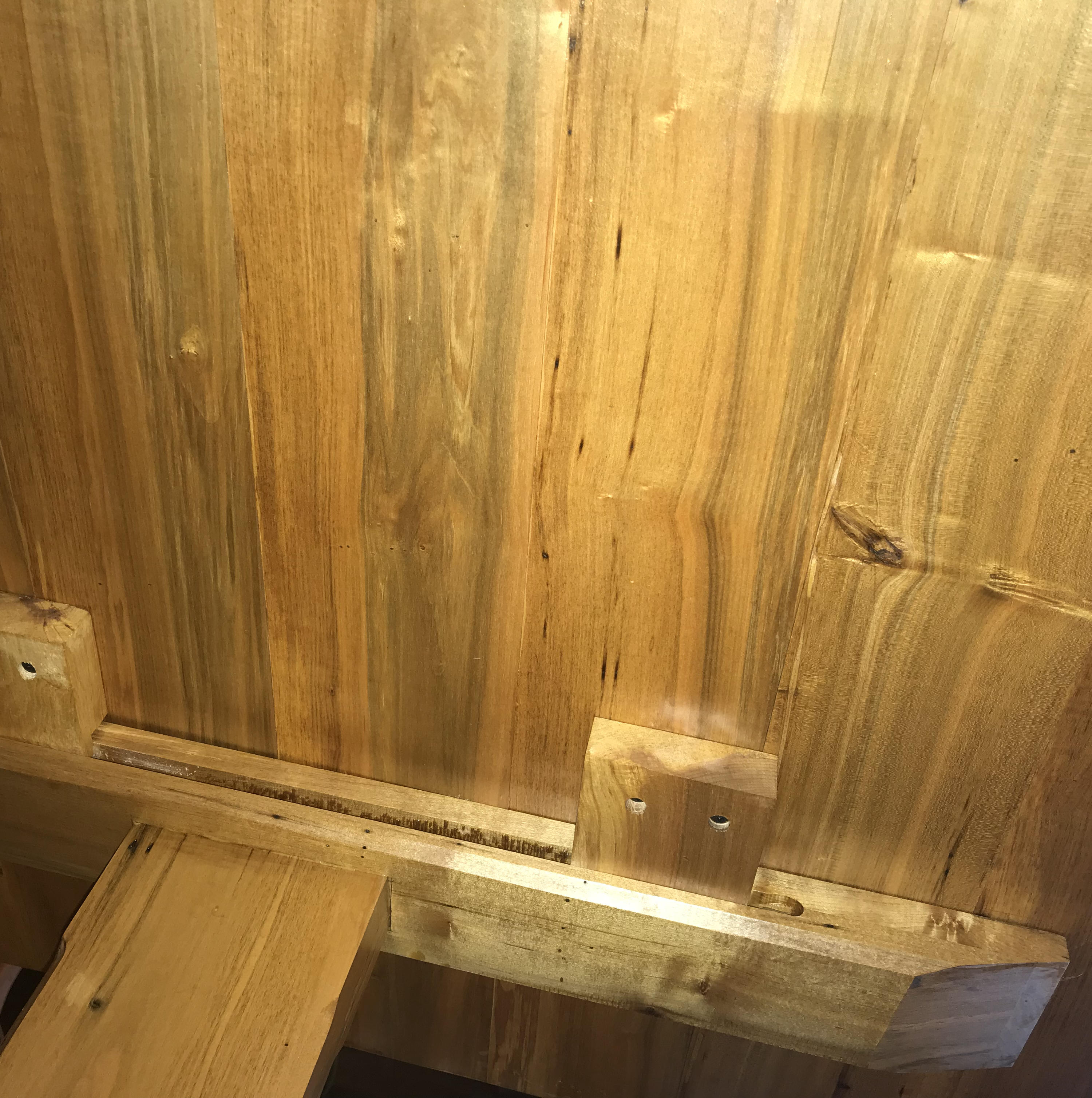
Under the Table

Once you have the lines mostly memorized, try changing your location.  If you only memorize in one place, when you get into a different environment you are more likely to forget what you learned.  (Don’t ask me how I know that.) This strategy also enhances engagement. By this time the brain feels like it’s at a faculty meeting so it tends to check out.  By putting yourself in a weird place, however, suddenly memorization seems fresh again. Lie under the kitchen table, stand on top of the dryer, sit in the back of the closet, yell lines at the ocean.  Not only will it feel quirky and new but your brain will also acclimate to multiple locales. When you get to the performance, your brain will think, “This isn’t as weird as dangling upside down from the monkey bars.”

A few last bits of advice:  set a schedule and adhere to it.  I usually have to memorize something three times before it truly sticks.  I think I have it, then the next day it’s gone. I learn it again, then it’s gone.  By the third time, though, it becomes much more firmly entrenched in long-term memory.  Knowing that I budget “forget time.” And, to reiterate, I have found that multiple blocks of short time work much better than fewer blocks of longer time.  So have at it and let me know how it goes!

Check out video post here: https://www.youtube.com/watch?v=ijapTY5-nfE